

“When the Deadlines Never Stopped, They Learned to Pause Anyway”
The rain had a habit of arriving in Bengaluru without warning, the way deadlines did at Vinayak’s office. He watched it streak down the glass wall of the fourteenth floor conference room, his laptop open to a dashboard full of numbers that refused to make sense anymore. Somewhere behind him, Reena’s voice cut through the hum of the air conditioning.
“I don’t care what time it is in your head, Vinayak. The client meeting is at nine tomorrow and I want that churn model validated tonight.”
“I have been at my desk since eight this morning, Reena,” he said quietly, not turning around.
“Everyone has been at their desk since eight this morning. That is called a job.” She picked up her tablet and walked out without waiting for a reply, her heels clicking against the floor like a countdown timer.
Vinayak closed his eyes for a moment. He was twenty eight years old, four years into a career in data analytics that had once excited him, the kind of work that felt like solving puzzles for a living. Lately it felt like drowning in spreadsheets that multiplied faster than he could breathe.
Down the corridor, in the glass fishbowl marked Cloud Infrastructure, Richa was finishing a call with a vendor in Singapore. She had a gift for making complicated things sound simple, a trait that had carried her from a small town in Uttar Pradesh to one of the busiest tech corridors in the country. She hung up, stretched her arms above her head, and noticed Vinayak through the glass, staring at his screen with the particular stillness of someone who was not really seeing it anymore.
She walked over and knocked lightly on the frame of his cubicle. “You look like a man who has forgotten what sunlight feels like.”
“I have,” he admitted, managing a tired smile. “Reena wants the churn model tonight.”
“Reena wants everything tonight. She wanted my migration report last night at eleven and then did not open it until this morning.” Richa pulled a chair and sat down across from him. “How many hours did you sleep yesterday?”
“Four, maybe five.”
“That is not a number, Vinayak, that is a warning.”
He shrugged, the kind of shrug people give when they have stopped expecting things to change. Richa did not push further right then. She had learned, through her own small battles with exhaustion, that people rarely listen to advice when they are still standing in the middle of the storm. Sometimes you had to wait until they stepped out for air.
That evening, Ganeshan was waiting for her at the small tea stall near their apartment in Indiranagar, two cups of ginger chai already steaming on the narrow wooden counter. He was an engineer in a different company altogether, but he and Richa had been roommates for three years and friends for longer, bound together by an unspoken agreement that success was not worth much if it emptied you out along the way.
“You look thoughtful,” he said, handing her a cup.
“I was thinking about Vinayak. He works with Gargi and me on the analytics side. He is brilliant, genuinely one of the sharpest people I have met, but he has that look now. The one you get right before you fall apart quietly, without telling anyone.”
Ganeshan nodded slowly. He had seen that look before, in his own mirror, two years ago, back when he used to reply to office messages at midnight and convinced himself that exhaustion was simply the price of ambition. It had taken a minor health scare, a racing heart at two in the morning that turned out to be nothing more than anxiety, to shake him into rethinking everything.
“You cannot fix him,” Ganeshan said. “But you can walk beside him for a while, if he lets you.”
Richa smiled into her cup. That was the quiet philosophy the two of them shared, neither loud activism nor grand declarations, just small consistent acts of care stitched into ordinary days. Take the stairs sometimes instead of the elevator. Turn the phone face down during dinner. Ask a colleague if they had eaten lunch, and actually wait for the answer.
The next morning, the churn model was ready, though Vinayak had barely slept to finish it. Reena barely looked at it before moving on to the next fire she wanted put out. In the same building, on the floor above, Gargi was staring at her own laptop with a headache that had settled behind her eyes like an uninvited guest. She was the kind of data scientist who could explain a neural network to a room of executives without a single slide, but lately her mind felt cluttered, unable to hold a single thought without three others crowding in behind it.
She found Ovi near the coffee machine on the eighth floor, the one place in the building that still smelled faintly of home cooked filter coffee instead of vending machine cardboard.
“You look tired, Gargi,” Ovi said gently. As the HR lead for the analytics vertical, she had spent the last few months quietly collecting a pattern she did not like, resignation letters that mentioned health reasons in careful, guarded language, sick leaves that clustered suspiciously around certain project deadlines, a general sense that something in the culture had grown brittle.
“I am fine,” Gargi said automatically, then paused, surprised at her own hesitation. “Actually, I am not sure I am fine. I keep forgetting small things. Yesterday I could not remember if I had eaten breakfast.”
Ovi did not rush to fix the sentence with reassurance. She simply listened, the way good listeners do, letting the silence hold space for whatever needed to surface. “Would you be open to talking to someone? The company has a counseling partnership now, completely confidential.”
Gargi hesitated. In the world she came from, admitting to stress still felt like admitting to weakness, a quiet shame passed down through generations that valued endurance over honesty. But something in Ovi’s steady, unhurried tone made the admission feel less like a failure and more like a fact, no different from saying she had a fever.
“Maybe,” Gargi said. “Let me think about it.”
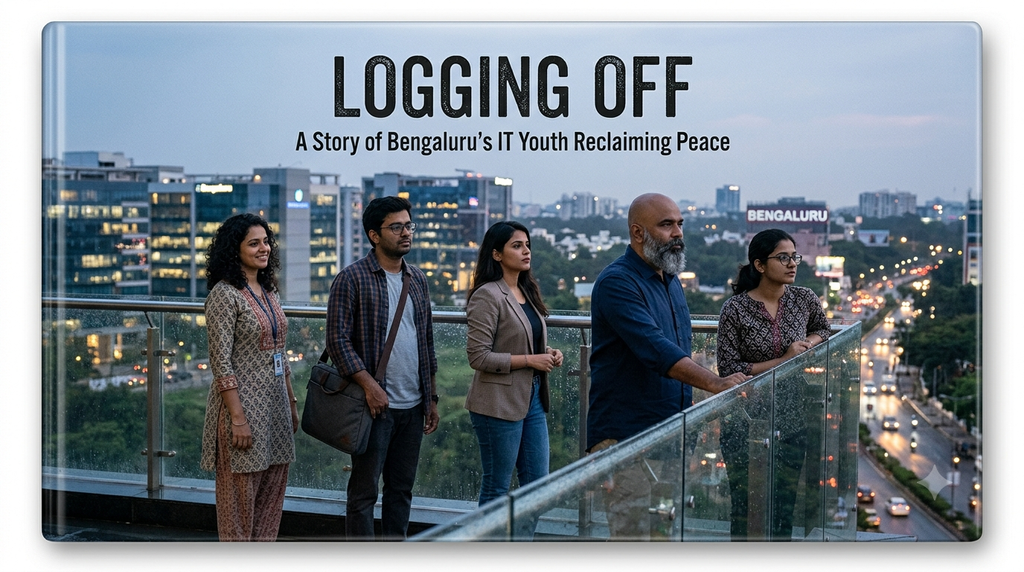
That weekend, Richa organized what she jokingly called an intervention, though it was really just a simple gathering on the terrace of her apartment building, plastic chairs arranged in a loose circle, a plate of samosas from the corner shop, and a sky finally clear of rain clouds. She had invited Vinayak, Gargi, and Ganeshan, framing it as nothing more than a casual evening among colleagues who had somehow become friends.
Vinayak arrived last, his eyes ringed with the particular tiredness that no amount of coffee could disguise anymore. He sat down heavily, and for a while nobody said much of anything, content simply to watch the city lights flicker on across the skyline.
It was Ganeshan who finally spoke. “I used to think burnout was a myth people used to excuse laziness. Then it happened to me, and I realized it is not laziness at all. It is your own body sending an emergency signal because your mind refused to listen to the smaller ones.”
“What changed for you?” Vinayak asked, his voice quieter than usual.
“I stopped treating rest as something I had to earn,” Ganeshan said. “I used to believe I could only relax after everything was finished, but in this line of work, nothing is ever finished. There is always another sprint, another release, another fire. So I decided rest had to come first, not as a reward but as a requirement, like eating or breathing.”
Gargi shifted in her chair. “Ovi asked me if I wanted to talk to a counselor. I keep saying maybe, but honestly, I think I am afraid of what I might discover about myself.”
“There is nothing shameful in it,” Richa said softly. “We check our laptops for viruses every week without a second thought. Why do we treat checking our own minds as something to hide?”
Vinayak stared at the samosa in his hand without eating it. “Reena told me yesterday that stress is simply the cost of a good salary. That if I wanted an easier life I should have chosen an easier career.”
“Reena believes her own value only exists in what she produces,” Ganeshan said, not unkindly. “That is a sad way to live, though I do not think she sees it that way. People like her often confuse exhaustion with dedication, and pressure with leadership. It does not make her right, and it certainly does not make her happy, even if she never says so.”
Richa leaned forward. “None of us can change Reena, and we probably cannot change the entire system overnight either. But we can change how we carry ourselves inside it. We can decide that our worth is not measured only by the number of hours logged into a laptop.”
Vinayak finally looked up, something loosening in his shoulders that had been tight for months. “I think I forgot that somewhere along the way. I used to run, you know, every morning before work, back when I first moved to this city. I do not remember when I stopped.”
“Start again tomorrow,” Gargi said, a small smile finding its way onto her face for the first time that week. “I will come with you. I clearly need it more than you do.”
Ganeshan raised his cup of chai like a toast. “To boundaries, then. And to remembering that work, however demanding, is meant to be part of our lives, not the whole of it.”
They laughed, a little tiredly but genuinely, and the sound carried out over the terrace into the warm Bengaluru night.
In the weeks that followed, small things shifted. Vinayak began logging off his laptop by eight most evenings, and though the world did not end, his reports somehow grew sharper, his mind clearer for the space it was finally given to breathe. Gargi met the counselor Ovi had suggested, tentatively at first, then with growing trust, learning to name the fog in her mind instead of simply enduring it. Richa and Ganeshan kept their quiet ritual of evening tea, a small anchor amid the churn of deadlines and deployments, proof that steadiness did not require grand gestures, only consistency.

Reena remained largely unchanged, still measuring her days in deliverables rather than moments, still unaware of the quiet cost her approach carried for the people around her. But something had shifted in how the others responded to her. They no longer absorbed her pressure as their own. They pushed back gently where they could, protected their evenings where they must, and reminded each other, again and again, that a paycheck was never meant to be purchased with a person’s peace of mind.
One evening, months later, Vinayak stood at the same glass wall on the fourteenth floor, watching the rain return in its familiar, unannounced way. This time, though, he was not staring blankly at a dashboard. He was simply watching the rain, letting himself notice it, the way he used to as a boy before deadlines had names and clients had time zones.
Richa found him there, two cups of chai in her hands, and passed one over without a word. They stood together in comfortable silence, two people who had learned, in their own imperfect way, that surviving the pressures of modern work did not mean surrendering to them. It meant choosing, again and again, to remain human inside a system that often forgot to ask if you were.
A History on Road Perspective
At History on Road, we believe every generation writes its own chapter of struggle and resilience, and today’s young IT professionals are no exception. The glass towers of Bengaluru may look different from the roads and villages we usually chronicle, but the human story inside them is timeless: the search for balance between ambition and wellbeing, between duty and self. Vinayak, Richa, Gargi, Ganeshan and Ovi are fictional, but their exhaustion, their small acts of courage, and their quiet reclaiming of peace reflect a very real crisis unfolding across India’s tech corridors today. We share this story not to criticize any industry, but to remind our readers that progress means little if it comes at the cost of a person’s mind and spirit. History on Road will continue to walk alongside these unseen journeys, because the roads worth remembering are not only the ones we travel, but the ones we choose to slow down on, together.
Outside, the city carried on in its restless hurry, but inside that small quiet moment, there was peace enough for both of them, and perhaps, if shared gently enough, peace enough to carry forward into someone else’s difficult day as well.



Borrowed Glory in Kalikapur: The Story of a Village Election