
A Historyonroad Story
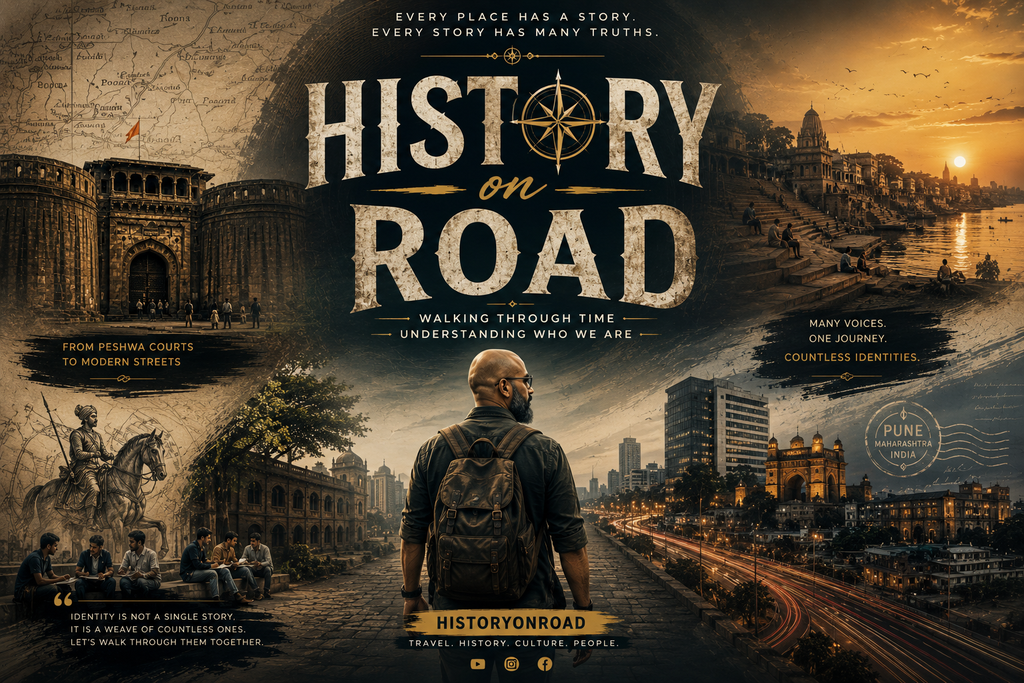
I have been walking the lanes of Pune since sunrise, and somewhere between the old Peshwa quarters and the quiet ghats of the Mula Mutha river, a question settled into my chest and refused to leave. My name is Ganeshan, and I have spent thirty years teaching history to restless teenagers who ask, more often than any textbook prepares you for, who am I, really. I used to answer with confidence. Today, standing before the crumbling wall of Shaniwar Wada, I am not so sure I have an answer at all.
Let me explain what brought me here.
The Morning That Started the Question
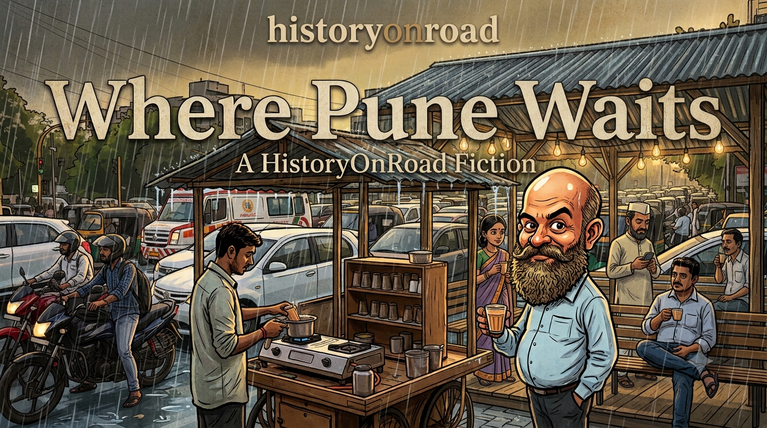
I began my day at a small tea stall near Tulshibaug, the kind of place where the owner remembers your order before you remember it yourself. An old friend, Satya, joined me. He is a psychologist by training, retired now, and he has the peculiar habit of turning ordinary conversations into something you carry home with you.
“Ganeshan,” he said, stirring his tea slowly, “do you think there is one real you?”
I laughed, the way people do when a question sounds too simple to matter. “Of course,” I said. “I am the same man whether I am teaching a class, arguing with my wife, or sitting here with you.”
Satya smiled the way teachers smile at students who have not yet done the reading. “Are you sure? You speak differently to your students than you do to your wife. You are patient with children and short tempered with traffic. You are generous with strangers and stubborn with your own brother. Which one is the real Ganeshan?”
I did not have an answer. I still do not, not fully. But the question stayed with me as I walked through the city that morning, and somewhere along the way, I began to see it everywhere, not just in myself, but in the streets, the monuments, and the very idea of the nation I call home.
Walking Through Layers
Pune is a city built on layers, and if you walk it slowly enough, each layer speaks in its own voice.
Near Shaniwar Wada, the air still seems to hum with the ambitions of the Peshwas, who once ruled from these very walls with a mixture of diplomacy and steel. A few streets away, the British era cantonment area carries a completely different rhythm, orderly roads, colonial bungalows, and a discipline that feels almost foreign to the chaos just beyond its boundary. Then there is the university area, alive with the energy of students from every state in the country, speaking a dozen languages before breakfast.
Which Pune is the real Pune?
Is it the Pune of warrior kings and courtly intrigue? The Pune of colonial order and resistance? The Pune of scooters and startups and students debating philosophy over vada pav? The truth, as Satya might say, is that Pune is not one of these. It is all of them, layered like sediment, each era leaving its mark without erasing the ones before it.
And is this not true of a nation as well?
The Nation as a Person
A country, much like a person, wears many faces depending on who is looking and when.
To a soldier standing at a distant border, the nation might feel like duty, sacrifice, and quiet pride. To a farmer watching the monsoon clouds gather, it might feel like hope tangled with worry. To a young entrepreneur in a glass office in Hinjewadi, it might feel like opportunity and ambition. To an elderly widow lighting a lamp in a village temple, it might feel like memory, tradition, and continuity.
None of these people are wrong. None of them holds the complete truth. And yet, together, they are the nation, not as a single fixed identity, but as a living conversation between many identities, some in harmony, some in tension, all part of the same evolving story.
I remembered then a lesson I used to teach my students about the many kingdoms and cultures that have called this land home over centuries, how they absorbed, resisted, blended, and transformed one another instead of simply replacing what came before. History rarely erases. It layers. And in that layering lies both our complexity and our strength.
A Conversation at the Ghats
By afternoon, I found myself sitting by the river, watching a group of children play cricket with a bat that had clearly seen better decades. An elderly man sat beside me, feeding pigeons with the unhurried patience of someone who has made peace with time itself.
We began talking, as strangers sometimes do when the setting invites honesty rather than small talk. His name was Purushottam, and he had lived through changes in this city that I could only read about in books, the transformation from a quiet Deccan town into a bustling metropolis of technology parks and traffic jams.
“You know,” he said, watching the children argue cheerfully over a disputed catch, “when I was young, we thought being Indian meant one specific thing. Now my grandchildren tell me being Indian means something different for each of them. My granddaughter in Bangalore says she feels most Indian when she is abroad, defending her culture to people who barely know where Pune is on a map. My grandson here feels Indian through his daily rituals, his festivals, his loyalty to this very neighborhood.”
“Are they both right?” I asked.
Purushottam nodded slowly. “I used to think only one version could be true. Now I think trying to force a single answer is where all our troubles begin. Communities fighting communities, regions resenting regions, ideologies clashing without listening, so much of it comes from insisting there is only one correct way to be who we are.”
His words landed heavier than he perhaps intended. I thought of history classes where I taught about conflicts born not from genuine difference but from the refusal to accept that difference could coexist peacefully within a single larger identity. Empires that fractured not because their people were incompatible, but because someone insisted compatibility required uniformity.
The Danger of Demanding One Truth
This is where the question of the real you becomes more than philosophy. It becomes a matter of consequence.
When we insist there is only one authentic version of ourselves, we often reject the parts of us that do not fit a chosen narrative. We suppress compassion because we have decided we are pragmatic. We suppress doubt because we have decided we are certain. The same happens at the level of nations and communities. When leaders or movements insist there is only one true way to belong, one true language, one true faith, one true history, they are not simplifying identity. They are amputating it.
I have read enough history to know where that path leads. Every conflict that scarred this subcontinent, every division that turned neighbor against neighbor, carried within it this same flawed premise, that identity must be singular to be legitimate. But identity, whether personal or national, has never worked that way. It never will.
The peace we long for, both within ourselves and between communities, does not come from resolving our contradictions into a single simple answer. It comes from learning to hold multiplicity with grace. The patient teacher and the frustrated driver can be the same man. The ancient warrior kingdom and the modern software hub can be the same city. The soldier’s duty and the farmer’s hope and the student’s ambition can all be the same nation, without any of them needing to defeat the others for the right to exist.
Evening Reflections Near the University
As the sun began to lower itself behind the hills, I walked toward Fergusson College Road, where students gathered in small circles, some debating politics, others simply enjoying the cooling air after a warm day. I overheard a young woman say to her friend, “I don’t think I have to choose. I can love my traditions and question them at the same time.”
I smiled, because without knowing it, she had answered the question that had followed me all day.
There may not be a single real you, not in the way we often imagine, a fixed core hiding beneath our shifting behaviors, waiting to be discovered once and for all. Perhaps the real you is not a hidden singular truth but the entire pattern itself, the full range of who you become across different moments, relationships, and circumstances, held together not by sameness but by continuity and care.
The same may be true for a nation. Its real self is not one ideology, one religion, one language, or one version of history triumphing over all others. Its real self is the entire layered story, the kingdoms and the resistances, the diversity and the shared struggles, the disagreements held together by a deeper commitment to coexist.
Walking Home
By the time I reached home, the city lights had begun to flicker on across Pune’s hills and valleys, each light representing a different home, a different story, a different version of what it means to belong here. I thought of Satya’s question from the morning, and Purushottam’s words by the river, and the young woman’s quiet wisdom near the college.
I still do not have a simple answer to whether there is one real me. But I have stopped searching for a single answer and started appreciating the many honest ones. I am the patient teacher and the tired man. I am shaped by ancient wisdom and modern doubts. I contain contradictions, and perhaps that is not a flaw to resolve but a richness to honor.
If nations, like people, could learn to hold their own contradictions with the same patience, perhaps fewer walls would be built between us, and more bridges instead. Perhaps understanding that identity is layered rather than singular is not just a philosophical comfort, but a practical path toward peace, one where difference is not a threat to be erased, but a history to be honored.
As I write this from my desk tonight, with the sounds of the city gently fading outside my window, I find myself hoping that more of us, as individuals and as nations, might walk our own version of this road, slowly, honestly, and without the need to force our many selves into one convenient shape.
Historyonroad Perspective
Every city we walk through on this journey teaches us that identity, whether of a person or a nation, is rarely a single thread. It is a weave, made of many voices, many eras, and many truths existing side by side. Pune, like so many places we have explored, reminds us that peace does not require sameness. It requires the willingness to let complexity coexist without conflict. At Historyonroad, we believe that walking through history with open eyes helps us understand not only where we came from, but how we might move forward together, with empathy, patience, and a shared respect for the many identities that make us who we truly are.