

A Bronze Machine That Rewrote What We Thought the Ancient World Could Build
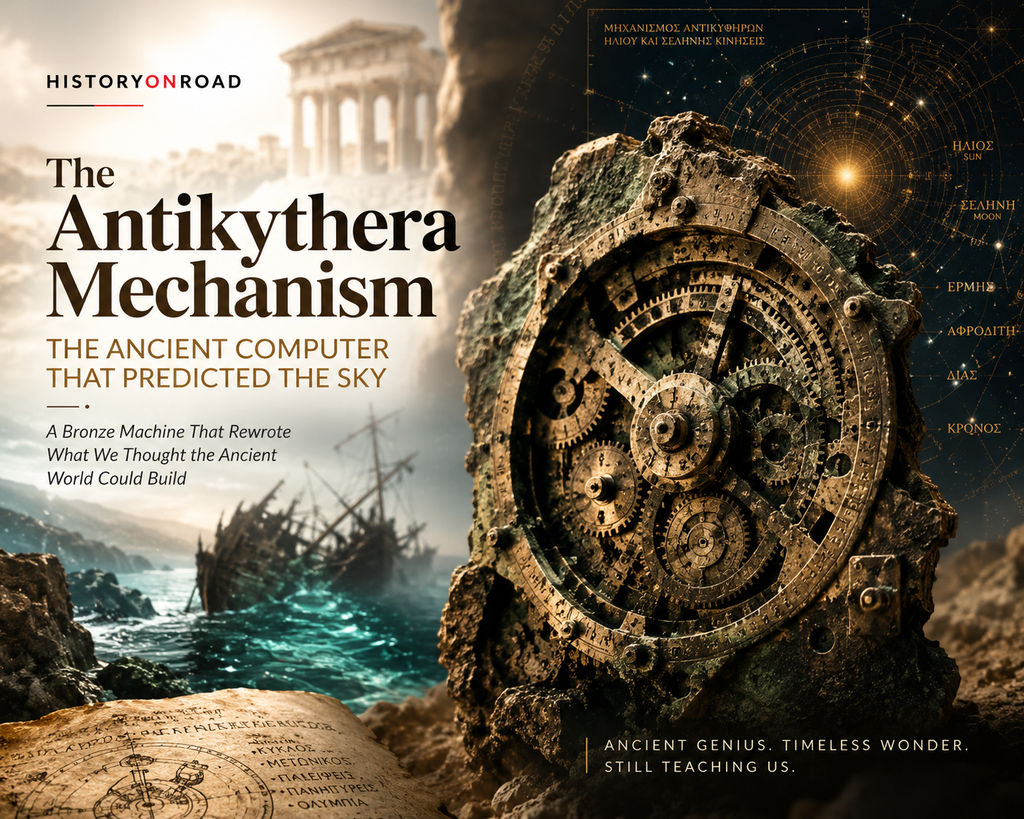
In the year 1901, a group of sponge divers working off the coast of a small Greek island called Antikythera stumbled upon something far more valuable than sponges. Resting on the floor of the Aegean Sea, inside the wreck of an ancient ship, was a corroded lump of bronze and wood, so encrusted with marine growth that it barely resembled anything man made. For years, it sat largely overlooked in a museum collection. Then, decades later, closer study revealed that this unassuming lump was in fact one of the most extraordinary objects ever recovered from antiquity, a device now known as the Antikythera Mechanism, often described as the world’s first analog computer.
This is the story of that machine, how it worked, why it stunned historians and scientists alike, and why understanding it matters even now, in a world defined by computing power its original creators could never have imagined.
A Discovery That Did Not Make Sense
When researchers first began examining the fragments recovered from the shipwreck, they expected to find something relatively simple, perhaps a decorative object or a basic astronomical tool. What they found instead was a complex arrangement of bronze gears, more than thirty in total, fitted together with a level of precision that seemed almost impossible for its time.
The device is believed to date back to somewhere between the second and first century BC, meaning it was built well over two thousand years ago. Yet nothing resembling this level of mechanical sophistication would appear again in the historical record for well over a thousand years. Clockwork mechanisms of similar complexity would not become common in Europe until the fourteenth century. This gap left historians with an uncomfortable question. How did a civilization without electricity, without modern metallurgy, and without precision manufacturing tools construct something this advanced, and then seemingly lose the knowledge to do it again for over a millennium?
What the Mechanism Actually Did
Modern research, aided by advanced imaging technology that could see inscriptions and gear teeth invisible to the naked eye, has revealed that the Antikythera Mechanism was designed to model the movements of the sun, the moon, and possibly the five planets known to the ancient world. By turning a hand crank, a user could move the gears forward or backward in time, and dials on the device’s face would display the position of celestial bodies for any given date.
The mechanism could predict lunar and solar eclipses years in advance, track the irregular movement of the moon through what is known as the Metonic cycle, and even display the timing of the ancient Olympic Games and other Panhellenic athletic festivals. In effect, this single bronze device combined the functions of a calendar, an astronomical predictor, and a scheduling tool for major cultural events, all within a case roughly the size of a large book.
To achieve this, its makers had to solve problems of gear ratios and mechanical timing that require a genuinely advanced understanding of astronomy and engineering. The moon’s motion across the sky is not perfectly regular, since its orbit is elliptical rather than circular. Remarkably, the mechanism accounted for this irregularity using a clever arrangement of offset gears, a solution that demonstrates real mathematical sophistication rather than guesswork.
Who Built It, and Why
The exact identity of the creators remains uncertain, and this mystery is part of what makes the Antikythera Mechanism so captivating. Some historians have connected it to the island of Rhodes, home to an active school of astronomy during the relevant period, and a place associated with scholars who studied under or were influenced by earlier Greek astronomers. Others have speculated about connections to the broader Hellenistic scientific tradition, a period in which Greek thinkers made significant advances in mathematics, engineering, and the study of the heavens, often building on ideas inherited from Babylonian astronomy.
What is clear is that the mechanism was not a toy or a novelty. Ancient societies placed enormous cultural and religious significance on the movement of celestial bodies. Eclipses were often seen as omens. Calendars needed to be synchronized with lunar cycles for religious festivals and agricultural planning. A device that could predict these events with mechanical reliability would have held real, practical value, not merely academic interest.
Lost Knowledge and a Long Silence
Perhaps the most sobering part of the Antikythera Mechanism’s story is what happened after it was built.
The ship carrying it sank, likely during the first century BC, and with it went not just the device itself but, it seems, much of the specialized knowledge required to design and build something like it. In the centuries that followed, as political instability, war, and the gradual decline of certain centers of scientific learning reshaped the ancient world, this particular strand of mechanical expertise appears to have simply faded away.
It would take well over a thousand years before mechanical clockwork of comparable intricacy reappeared in human history. This gap illustrates something important and somewhat unsettling, the fact that technological progress is not automatically permanent. Knowledge can be lost, not through some dramatic catastrophe alone, but through the quiet erosion of institutions, funding, and the transmission of skill from one generation of craftsmen and scholars to the next.
Why the Antikythera Mechanism Matters in 2026
In 2026, humanity is once again in the middle of a period defined by rapid technological acceleration, this time centered on artificial intelligence, advanced computing, and systems capable of modeling extraordinarily complex phenomena, from climate patterns to financial markets to the human genome. The Antikythera Mechanism offers a useful and humbling point of reflection amid all of this progress.
First, it is a powerful reminder that the human desire to model, predict, and understand the natural world is not new. The impulse behind building a machine to predict eclipses is fundamentally the same impulse behind building a modern climate model or an AI system trained to forecast weather patterns. We are, in a very real sense, continuing a project that began thousands of years ago, refining our tools rather than inventing the underlying ambition from scratch.
Second, and perhaps more importantly, the mechanism is a caution against assuming that progress only moves in one direction. Knowledge systems, whether mechanical, digital, or institutional, require continuous maintenance, transmission, and investment. In an era where critical infrastructure, scientific expertise, and even basic digital literacy can be disrupted by conflict, economic instability, or simple neglect, the story of a remarkable technology that vanished for over a thousand years feels less like ancient trivia and more like a warning worth taking seriously.
There is also a quieter lesson here about patience and precision. In an age often obsessed with speed, where technology is expected to update, iterate, and improve at breakneck pace, the Antikythera Mechanism was the product of painstaking, careful craftsmanship, almost certainly built and refined over a long period of sustained effort. It stands as proof that some of the most enduring achievements in human history were not rushed. They were built to last, and in this case, they very nearly did, surviving over two thousand years at the bottom of the sea to still amaze us today.
The Long Road to Understanding It
For much of the twentieth century, the Antikythera Mechanism sat in a museum collection in a fragmented, corroded state, studied but not fully understood. Early researchers recognized that gears were involved, and some proposed astronomical functions, but the full complexity of the device remained hidden beneath layers of calcified marine deposit and centuries of corrosion. It was only with the arrival of more advanced imaging technology, including high resolution X ray computed tomography scans conducted in the early twenty first century, that researchers were finally able to see inside the fragments without physically damaging them further.
These scans revealed inscriptions far too small to read with the naked eye, essentially a kind of ancient instruction manual etched directly onto the device itself, describing its functions and how to interpret its various dials. This discovery transformed the mechanism from a fascinating but poorly understood curiosity into one of the most thoroughly documented pieces of ancient technology ever recovered. It also demonstrated something important about the nature of historical research itself, that our understanding of the past is not fixed, but continues to evolve as new tools and techniques become available, sometimes revealing entirely new layers of meaning within objects that had already been studied for generations.
The story of the mechanism’s decoding is, in many ways, as remarkable as the device itself, involving decades of collaboration between archaeologists, astronomers, engineers, and historians, each contributing specialized expertise to gradually piece together how the gears, dials, and inscriptions worked together as a unified system. This kind of sustained, interdisciplinary effort offers its own quiet lesson about the value of patience and collaboration in tackling genuinely difficult problems, whether ancient or modern.
What the Device Tells Us About Ancient Scientific Ambition
Beyond its impressive engineering, the Antikythera Mechanism reveals something important about the scientific culture that produced it. Its builders were not merely interested in tracking time for practical, immediate purposes. They were attempting to model the underlying mathematical patterns governing the movements of celestial bodies, an ambition that reflects a genuinely scientific mindset, seeking to understand the rules underlying observed phenomena rather than simply recording those phenomena as they occurred.
This ambition connects directly to the broader intellectual tradition of the Hellenistic period, a time when Greek scholars made substantial advances in geometry, astronomy, and mathematics, often building upon earlier Babylonian astronomical records while developing new theoretical frameworks of their own. The mechanism stands as physical proof of just how far this theoretical knowledge had already been translated into practical, functioning technology, well before many historians had previously assumed such capability existed.
Rediscovering Wonder Through an Ancient Machine
There is something profoundly moving about the fact that this device sat quietly at the bottom of the Aegean Sea for nearly two thousand years, only to be pulled up by chance and, even then, not fully understood for decades afterward. It challenges any comfortable assumption that we already know the full extent of what ancient civilizations were capable of achieving. Each new imaging technique applied to the fragments has revealed more inscriptions, more gear teeth, more evidence of a level of sophistication that continues to surprise even specialists in the field.
This ongoing process of discovery is itself instructive. It suggests that our understanding of history, much like our understanding of the universe the mechanism was designed to model, is never truly finished. There is always more detail waiting to be uncovered, provided we remain curious enough to keep looking closely at what has already been found.
The Historyonroad Perspective
At Historyonroad, the Antikythera Mechanism represents everything we find compelling about ancient history, a story that refuses to stay comfortably in the past. It forces us to reconsider what “ancient” truly means, and it reminds us that brilliance, precision, and scientific ambition are not modern inventions but recurring threads woven throughout human history. We are drawn to stories like this because they connect directly to conversations happening right now, in 2026, about technology, knowledge preservation, and the fragile, non-guaranteed nature of progress. A two thousand year old bronze machine, recovered from a shipwreck, still has something urgent to tell us about how we build, how we lose, and how we might work harder to preserve what future generations will one day look back on as our own remarkable achievements.