
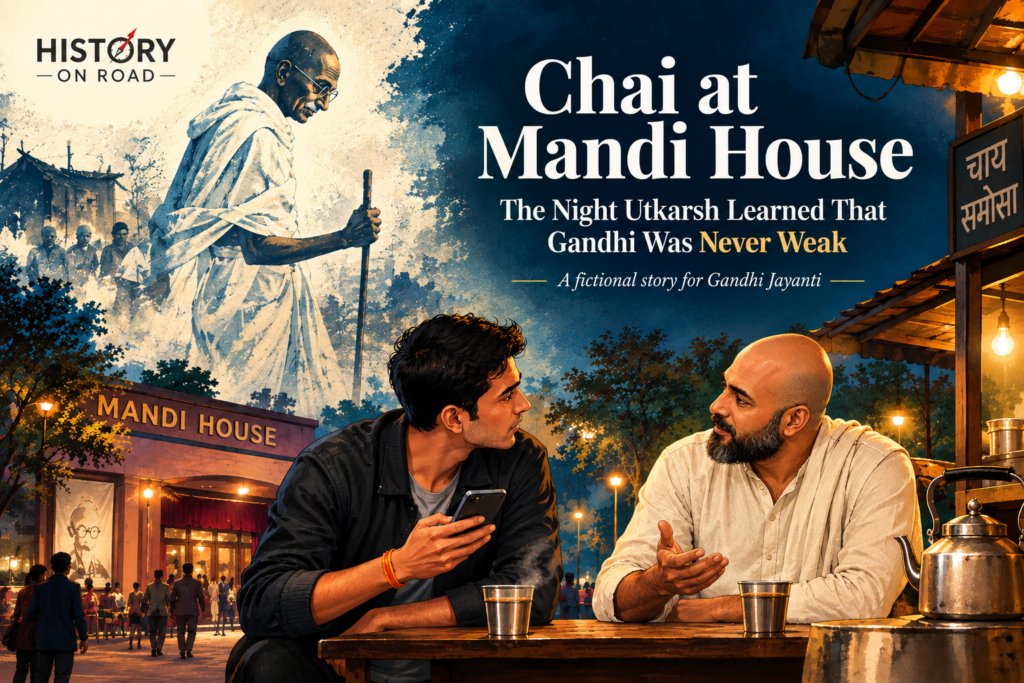
A Fictional Story for Gandhi Jayanti – 2nd October 2026
The lights went down on the last scene, and for ten full seconds nobody in the small auditorium clapped. Then the whole hall rose together.
The play was called Aakhri Kadam, “The Last Step.” It had no film stars, no music, and no budget beyond a bare stage and one old charkha. Its single actor, a thin man in a white dhoti, had spent ninety minutes walking barefoot through the villages of Noakhali in 1946, among burning homes and frightened people, asking neighbours not to kill each other.
Outside, the October air of Delhi was cool and smelled of woodsmoke and cardamom. At the tea stall across from Mandi House, old Ramprasad was pouring chai into steel glasses for the crowd that had spilled out of the theatre.
Ganesh, fifty-two, a soft-spoken man in a plain khadi kurta, stood at the corner of the stall with his glass, still looking at the stage door. He had travelled from Pune for this show. Every year on 2nd October he stayed away from speeches and slogans and went to find something quiet and honest instead.
“Bhaiya, one more cutting,” a voice said behind him. It was loud and bored, the voice of someone who had been dragged somewhere and wanted everyone to know.
Ganesh turned. A young man of about twenty-four stood there in a branded jacket, with a saffron band on his wrist and a phone in his hand, scrolling. This was Utkarsh, from a comfortable family in Uttar Pradesh. He was in Delhi for an “internship” that his father’s friend had arranged, and his cousin had bought the theatre tickets.
“Waste of an evening,” Utkarsh said to his cousin, who had already slipped away to take a call. He said it loudly enough for the whole stall to hear. “Two hours of Gandhi-Gandhi. As if he did anything. Everybody knows he only got us a partition. A sick old man in a loincloth, and now we have to celebrate him with a national holiday.”
A few heads turned. The tea-seller’s hand paused over the kettle.
Ganesh did not frown. He smiled the way a man smiles when he hears a child say something he will gently correct later. “Beta,” he said, “the tea is good here. Would you like to have a glass with me? My treat.”
Utkarsh looked him up and down, taking in the cotton kurta, the rubber chappals and the cloth bag. “You’re one of those Gandhi types,” he said. “Let me guess. Maharashtra?”
“Pune,” said Ganesh. “And yes, I try to be a Gandhi type. I’m not good at it yet. Sit, please.”
Whether it was curiosity or just habit, Utkarsh sat. Ramprasad slid two glasses across the wooden plank. Steam rose between the men.
“You said Gandhi gave us nothing but partition,” Ganesh began. He did not raise his voice, and he did not say you are wrong. “Can I ask you one thing? Which book of his did you read to reach that conclusion?”
Utkarsh laughed. “I don’t need to read him. Everyone knows. It’s all on WhatsApp, on YouTube. Videos with millions of views.”
“Ah,” said Ganesh. “And who made those videos?”
“People who know history.”
“Did you check what they studied? Where? Which archives?”
Utkarsh paused for a moment. “Why should I? They said it with proof.”
“A screenshot,” Ganesh said gently. “Beta, I am not angry. I would like to share a few facts with you, and then you can decide whether they sit with your WhatsApp. Is that fair?”
Utkarsh shrugged, which from him counted as yes.
“In 1917,” Ganesh said, “there was a place called Champaran in Bihar, where poor farmers were forced by British planters to grow indigo on part of their own land. They were beaten and taxed for refusing. Nobody was going to help them, not the courts, not the rich, not the leaders sitting in big cities. A man came from Gujarat, who had no army, no money and no title. He walked into the villages, listened to the farmers, and wrote down thousands of their statements. In a few months the government had to set up an enquiry. That was Gandhi’s first satyagraha on Indian soil. No gun was fired. Not one bullet.”
Utkarsh took a sip of tea. He did not interrupt.
“In 1930 he decided to break the British salt law. Salt, beta, the cheapest thing in every kitchen. The British taxed it and made it illegal for ordinary Indians to make their own. Gandhi walked 240 miles from Sabarmati to Dandi with seventy-eight people, and by the time he reached the sea, thousands had joined. He bent down, picked up a lump of natural salt, and the whole empire shook, because he had shown that the poorest Indian could say no to the most powerful government on earth and win without raising a hand. Some of the greatest newspapers in the world wrote about it. Do you know why? Because nobody had ever seen a revolution that was an act of cooking.”
Someone nearby laughed softly. Even Ramprasad was listening now, wiping the same glass again and again.
Utkarsh shifted on the bench. “Okay, but that’s all old stories. Today’s reality is different. He was weak. He told us not to fight back. What kind of nation does not fight back?”
“That,” said Ganesh, “is the most important question you’ve asked, and I’m glad you asked it, because it is exactly what Gandhi was asked a thousand times. Let me ask you something. Is it bravery to hit someone who hits you?”
“Of course.”
“A stray dog also bites when bitten. Is that bravery?”
Utkarsh opened his mouth and closed it again.
“Gandhi said, and I am paraphrasing, that non-violence is the weapon of the strong, not the weak. To stand in front of a lathi with no weapon in your hand and no hatred in your heart requires a courage most of us will never have. Think of the men who stood in line at the Dharasana Salt Works in 1930. They were beaten to the ground one after another, and each of them rose again without raising a fist. A journalist who watched it wrote that he had never seen anything like it, and his report shook the opinion of the world.”
Ganesh turned his glass slowly. “And one more thing. The weakest people on earth are those who can only act when they feel hate. Gandhi trained ordinary men and women, shopkeepers, farmers, students, grandmothers, to stay calm when they were furious, to stay truthful when lying was easier, and to stay together when division was easy. Is that weakness? It is the hardest discipline a human being can attempt.”
Utkarsh stared at his phone, but the screen had gone dark. He had not noticed.
“Fine,” he said finally, a little less sure of himself. “But he was against Hindus. He kept making peace with the other side. He fasted for them.”
Ganesh nodded slowly. “Let me tell you about 1947, beta. When the country was free in August, Gandhi did not go to Delhi to celebrate. He sat in Calcutta, in a house in a Muslim neighbourhood, because the city had been burning with riots. People threw stones at him. Then he began a fast, and slowly the violence subsided. Lord Mountbatten, the last Viceroy, a man who had no reason to flatter an Indian, wrote that in Punjab he had fifty-five thousand soldiers and still could not stop the killing, while in Bengal his entire force was one man and there was peace. He called Gandhi a one-man boundary force.”
Ganesh let that sit.
“And in January 1948, in this very city, this city where we are sitting, Gandhi fasted again, asking only that Delhi’s Muslims be allowed to live safely in their own homes. Not for a flag, not for a seat, not for a party. For neighbours. A few days later he was shot in the chest while walking to his evening prayer. Do you know what he said?”
“Hey Ram,” Utkarsh murmured, almost without meaning to. It was something he’d heard at school.
“Hey Ram,” Ganesh agreed. “The man who is mocked today for supposedly being against Hindus died with the name of Ram on his lips. His favourite hymn was Vaishnav Jan To, the song of a true devotee, one who feels another’s pain as his own. He believed Ishwar and Allah were two names for one truth. That’s not anti-Hindu, Utkarsh. That’s the deepest Hindu idea there is, sarva dharma sambhava. All paths lead to the one.”
The tea had gone cold in both glasses, and neither man noticed.
“You want to know the funniest part?” Ganesh said, now with a hint of warmth. “I have read criticisms of Gandhi. Honest ones. Dr Ambedkar disagreed with him about separate electorates, and their debate was fierce, and they eventually reached the Poona Pact in 1932. Many historians have questioned Gandhi’s views on caste, on women, on economics. These are serious questions. A man like Gandhi welcomes them. He himself wrote an autobiography titled My Experiments with Truth, in which he lists his own mistakes without hiding them. That is how brave he was.”
“But the people you meet online,” Ganesh continued, “the ones who shout filthy things about him, how many of them have read Hind Swaraj? How many have read Young India? How many have read his letters? Almost none. They have read each other. And they are only repeating a sentence they heard from someone who also did not read.”
Utkarsh’s face had reddened slightly, but not with anger. It was closer to embarrassment. “I didn’t think about it like that,” he said quietly. “I just… everyone in my group says it.”
“Because it is easy to say,” said Ganesh. “It takes one second to say something false and a lifetime to learn what is true. That is why Gandhi called his life a journey of satya, truth. Truth is slow, beta, and today we are all in a hurry.”
A cold breeze came down the road from Barakhamba. Across the street the last of the theatre crowd was leaving. The old man in the white dhoti, the actor, was walking out with a small bag over his shoulder, and a few young students were touching his feet.
Utkarsh watched them for a while. “What do I do?” he asked, and the arrogance was gone from his voice. “I mean, if I want to know the real thing.”
Ganesh reached into his cloth bag and pulled out a small, worn book, its cover soft from many readings. It was An Autobiography, or The Story of My Experiments with Truth.
“Read this. Not on your phone. Hold the book. Read slowly, a few pages every night. When you disagree with something, and you will, because you are an honest young man underneath all this, write down why. Argue with him in the margin. That is what he would want. He never asked anyone to worship him. He asked them to think, to test, to experiment.”
“This is your copy,” Utkarsh said, turning it over.
“It was my teacher’s. Now it is yours. I’ll find another.”
Utkarsh did not know what to say. In his whole life, no one had given him something of value without wanting something in return.
“One thing more,” Ganesh added, rising and folding his cloth bag over his shoulder. “You can disagree with Gandhi. You can criticise him. But before you speak, please walk a few miles in his footsteps. Read what he read and fast as he fasted, if only for a day. Then come back and tell me what you think. I will listen, I promise. And if after all that you still disagree, then at least your disagreement will be your own, not something borrowed from a stranger’s video.”
He paid Ramprasad for the two glasses, and the old tea-seller, who had not said a word all evening, folded his hands and nodded at him.
Months later, on a quiet morning in Pune, a letter arrived at Ganesh’s door. The handwriting was uneven, the paper of the cheap kind sold at railway stations.
Ganesh ji,
I finished the book. It took me four months. I disagreed with him on many things, and I wrote all of it in the margins, as you said. But I want to tell you what I did not expect. I went to Dandi last week. I walked a little of the road. An old woman in a village gave me water and would not take money. When I told her I was from UP, she smiled and said, “Gandhi ji belonged to everyone.” I stood there and I could not speak.
I deleted the groups. I am still learning. Thank you for the chai.
— Utkarsh
Ganesh read it twice, then folded it carefully and placed it inside the first page of another worn copy of the same book, the one he had found to replace the one he gave away. He looked out of the window, where the morning sun was rising over the rooftops of Pune.
“The experiment continues,” he said to nobody in particular.
Gandhi Jayanti is not just a day to garland a photograph. It is a day to ask ourselves whether we have actually read the man, and whether we are brave enough to follow even a fraction of what he asked of us. Questioning Gandhi is fine. Questioning him without reading him is not.
Satyameva Jayate. Happy Gandhi Jayanti.
Hashtags:
#GandhiJayanti, #MahatmaGandhi, #Satyagraha, #Ahimsa, #IndianHistory, #HistoryOnRoad
Category:
History, Fiction, Indian Heritage, Social Awareness