

What Broken Pottery Shards Reveal About Protecting Democracy From Within
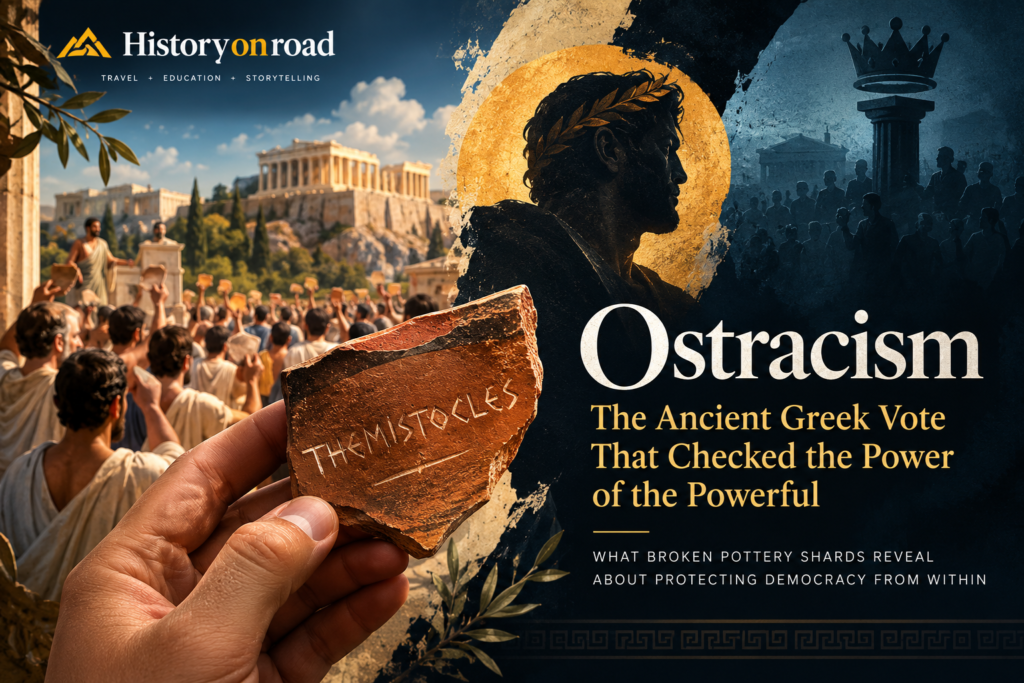
In ancient Athens, widely regarded as the birthplace of democratic governance, citizens developed a striking and unusual political tool designed to address a very specific concern, the fear that a single individual might accumulate so much power, popularity, or influence that they could threaten the stability of the democratic system itself. That tool was ostracism, a formal process through which Athenian citizens could vote to temporarily exile a prominent figure from the city for a fixed period, not necessarily as punishment for any specific crime, but as a preventative measure against the concentration of dangerous political power. This is the story of how ostracism worked, why it was created, and why its underlying concern remains genuinely relevant to democratic societies navigating questions of power and accountability in 2026.
A Vote Written on Broken Pottery
The process of ostracism took its name from the ostrakon, a piece of broken pottery, since pottery shards were cheap, widely available, and easily inscribed, making them a practical and accessible medium for what was, in effect, a large-scale public vote. Once each year, Athenian citizens were given the opportunity to hold an ostracism vote, though it required a specific quorum to actually proceed. If enough citizens voted to move forward with the process, each participating citizen would scratch the name of a person they wished to see ostracized onto a broken piece of pottery.
If a sufficient number of votes were cast, generally requiring several thousand participating citizens according to most historical accounts, the individual receiving the most votes would be required to leave Athens for a fixed period, typically ten years. Importantly, ostracism did not involve any formal accusation of a specific crime, nor did it result in permanent exile, loss of citizenship, or confiscation of property. The exiled individual’s civic rights and property generally remained intact, and they were expected, and legally entitled, to return to full participation in Athenian society once their fixed period of exile concluded.
A Tool Aimed at Preventing Power, Not Punishing Crime
What makes ostracism particularly notable, and distinct from many other historical mechanisms of political punishment, is its explicitly preventative rather than punitive purpose. The process was not designed to punish an individual for committing a specific wrongdoing, but rather to address the broader, structural concern that any single person, regardless of their intentions, accumulating enough popularity, wealth, or political influence, could potentially destabilize the collective, shared nature of Athenian democratic governance.
Historical accounts suggest that ostracism was sometimes used against individuals suspected of harboring ambitions toward establishing themselves as a tyrant, a term in ancient Greek political thought referring specifically to a single ruler who seized or held power outside of established democratic or legal processes, regardless of whether that ruler happened to govern well or poorly. At other times, ostracism appears to have functioned more directly as a tool of ongoing political rivalry, used strategically by competing political factions to remove influential opponents from the political arena for an extended period, illustrating that even well-designed democratic tools can be shaped and sometimes misused by the practical realities of political competition.
The Value, and the Limits, of the System
Ostracism reflects a genuinely sophisticated piece of early democratic theory, the recognition that protecting a shared system of governance sometimes requires more than simply punishing clear violations of established law. It requires actively, deliberately addressing the accumulation of dangerous, destabilizing concentrations of individual power before such power can be misused, rather than waiting for clear evidence of wrongdoing to emerge only after significant damage may have already occurred.
At the same time, historical study of how ostracism was actually used in practice reveals real limitations and vulnerabilities within the system. Because votes were often influenced heavily by rhetoric, personal popularity, and the strategic maneuvering of competing political factions, rather than purely objective assessment of genuine democratic risk, ostracism could, and at times clearly did, become a tool wielded for narrower political advantage rather than its original, broader protective purpose. Several historically significant Athenian political and military figures were ostracized during periods of intense political rivalry, in ways that later historians and even some ancient commentators have questioned as reflecting political maneuvering more than genuine, sober concern about a specific threat to the democratic system itself.
This dual legacy, a genuinely valuable democratic safeguard that was nonetheless vulnerable to misuse and political manipulation, offers a nuanced, historically grounded lesson rather than a simple, uncomplicated success story.
Distinguishing Ostracism From Ordinary Political Rivalry
It is worth noting how ostracism differed structurally from the ordinary political disagreement and rivalry that occurs within any functioning democratic system. Athenian democracy featured vigorous, sometimes intense debate and competition between rival political figures and factions as an entirely normal, expected part of civic life, similar to political competition found within modern democratic systems today. Ostracism was designed to sit apart from this ordinary competitive process, intended specifically to address situations where an individual’s accumulated power or influence had grown significant enough to potentially threaten the collective, shared nature of the democratic system itself, rather than simply serving as a tool for settling routine policy disagreements or personal political rivalries.
This distinction, between healthy, ordinary democratic competition and a specific, deliberate safeguard against dangerous concentrations of power, is important to keep in mind when drawing comparisons to modern institutions. Not every modern regulatory or oversight mechanism aimed at powerful individuals or organizations is equivalent to ostracism, nor should it be. The genuine lesson of ostracism lies specifically in its underlying recognition that healthy democratic systems benefit from having some deliberate, structured mechanism for addressing dangerous concentrations of power, distinct from ordinary political competition, a narrower and more specific insight than simply endorsing any and all forms of political conflict or opposition.
Why Ostracism Matters in 2026
In 2026, democratic societies around the world continue to actively grapple with strikingly similar underlying questions, how should a healthy, functioning system respond to the accumulation of significant individual power, whether political, economic, or increasingly, technological, before that concentration of influence potentially threatens broader collective governance and accountability. Modern democratic systems have developed a wide range of tools intended to address exactly this concern, including term limits, campaign finance regulations, independent judicial oversight, antitrust and competition law, and various institutional checks and balances distributed deliberately across different branches and levels of government.
The ancient Athenian approach to ostracism offers a genuinely valuable historical case study for these ongoing modern conversations, illustrating both the legitimate underlying concern, that concentrated power poses real risks to collective democratic governance regardless of the specific intentions of the individual holding it, and the practical challenges involved in designing a genuinely fair, well-calibrated system for addressing that concern without the process itself becoming vulnerable to misuse for narrower political advantage.
This tension feels particularly relevant given ongoing modern debates around the growing influence of extremely large technology companies and individual figures within the technology industry, whose accumulated economic and informational power in some cases arguably rivals or exceeds that of many traditional political institutions. Just as ancient Athenians grappled with how to address individuals who, through popularity, wealth, or influence, might destabilize their democratic system regardless of clear legal wrongdoing, modern societies continue actively debating how existing regulatory and legal frameworks should evolve to address similarly significant, non-traditional concentrations of power in the current technological and economic landscape.
There is also a valuable, more general lesson here about the ongoing, active maintenance genuine democratic systems require. Ostracism reflects an important recognition that healthy democratic governance is not simply a matter of establishing good foundational laws once and assuming the system will remain stable indefinitely without further active attention. It requires ongoing, deliberate mechanisms for identifying and addressing emerging risks to collective governance, mechanisms that, as the mixed historical record of ostracism itself demonstrates, must themselves be carefully designed, and continuously refined, to avoid becoming tools of narrow political advantage rather than genuine, broadly shared democratic protection.
Notable Cases From Athenian History
Historical records, though incomplete, preserve several notable examples of ostracism in practice, offering valuable insight into how the process actually functioned within Athenian political life. Themistocles, a prominent Athenian statesman and military leader credited with strengthening Athens’s naval power during a critical period of conflict with Persia, was himself eventually ostracized, reportedly amid shifting political alliances and growing suspicion regarding his continued influence, despite his earlier significant contributions to the city’s security and success.
Aristides, another significant Athenian political figure known by the epithet the Just for his reputation of fairness and integrity, was also ostracized at one point, according to some ancient accounts, in part simply because his consistent reputation for virtue and fairness had made him a perceived political obstacle to certain rival factions, an account that, whether entirely accurate or partly embellished by later historians, nonetheless illustrates the genuine risk that even broadly respected, capable leaders could become targets of the ostracism process for reasons only loosely connected to its original protective purpose.
These historical cases illustrate clearly why ostracism cannot be viewed simply as an unambiguous democratic success story. It functioned, in practice, as a genuinely double-edged tool, capable of protecting Athenian democracy from real, legitimate threats of concentrated power, while simultaneously remaining vulnerable to manipulation by competing political interests pursuing their own more narrow advantage. This complexity is precisely what makes the historical study of ostracism so valuable for modern audiences, offering a genuinely honest, nuanced case study rather than an oversimplified lesson.
A Reminder About the Fragility of Shared Systems
Ostracism, ultimately, reflects a level of political maturity and self-awareness worth genuinely appreciating, the recognition, by the citizens of ancient Athens themselves, that their democratic system, however innovative and admired, remained genuinely fragile and required active, ongoing protection from the risks posed by concentrated individual power. This self-aware humility about the vulnerability of shared democratic systems, even those functioning reasonably well, represents a valuable historical lesson entirely separate from the specific mechanics of the ostracism process itself.
Why the Process Eventually Faded
Ostracism gradually fell out of regular use in Athens during the latter part of the fifth century BC, with historical accounts suggesting the process became increasingly associated with narrow political maneuvering rather than its original, broader protective purpose, ultimately undermining public confidence in its legitimacy and value. This gradual decline offers its own valuable lesson, that even genuinely well-intentioned democratic safeguards can lose their effectiveness and public trust if they come to be perceived as tools of political convenience rather than principled, broadly applied protection.
This pattern, a valuable institutional safeguard gradually losing legitimacy through perceived misuse, echoes clearly in modern discussions about various contemporary checks on power, from judicial review processes to legislative oversight mechanisms to campaign finance regulation, all of which similarly depend on sustained public trust in their fair, principled application to remain genuinely effective over time. The eventual fading of ostracism from Athenian political practice is not simply a historical footnote. It stands as a clear, practical reminder that maintaining genuine trust in democratic institutions requires ongoing vigilance, transparency, and consistent, principled application, not simply the initial, well-intentioned creation of the safeguard itself.
The Historyonroad Perspective
At Historyonroad, the story of ancient Greek ostracism resonates strongly with our broader mission, using historical examples not simply to entertain, but to genuinely illuminate the complex, ongoing challenges democratic societies continue to face today. It would be easy to treat ostracism as simply a curious, somewhat strange ancient political practice, worth a brief historical mention before moving on. We believe it deserves considerably more serious attention than that. In a world of 2026 actively debating how to responsibly address significant concentrations of power across political, economic, and technological domains, the imperfect but genuinely thoughtful ancient Athenian experiment with ostracism offers a valuable, historically grounded starting point for exactly these ongoing, urgent modern conversations.
Category: History
Hashtags: #AncientGreece, #Democracy, #AncientHistory, #Athens, #Ostracism, #PoliticalHistory, #historyonroad



Borrowed Glory in Kalikapur: The Story of a Village Election