
Empowerment Is Responsibility, Not a License
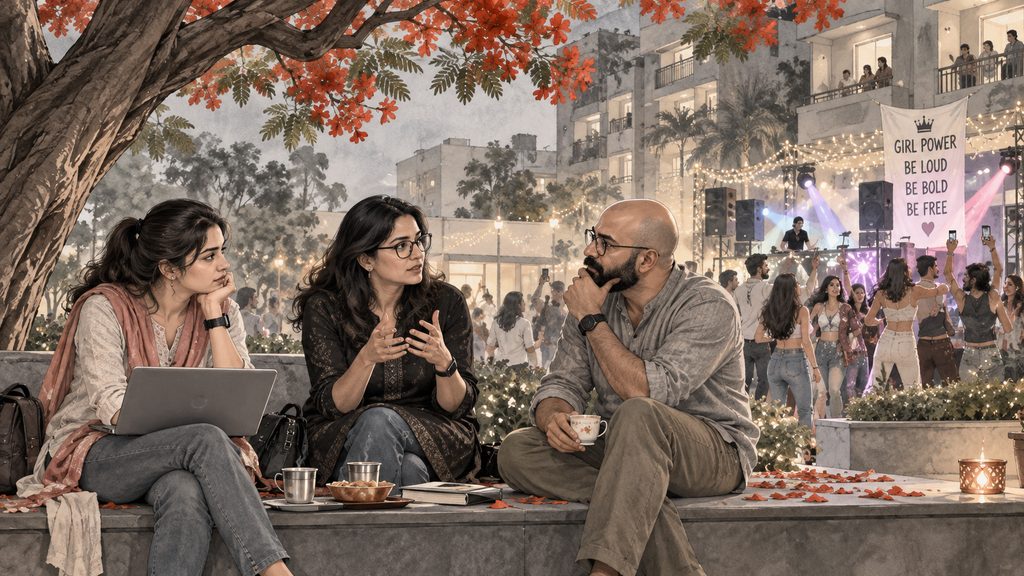
The gulmohar tree in the courtyard of Sunrise Meadows Residency, an apartment society on the edge of Bengaluru, had seen many evenings like this one. Its red petals drifted onto three steel cups of tea.
Aditi, twenty-nine and a software engineer, sat with her dupatta tucked neatly over her shoulder. Beside her was Richa, thirty-six, a senior IT manager with sharp eyes and a sharper sense of humor. Across from them sat Ganeshan, forty-three, a quiet scholar of Indian social history who spent his days among books and his evenings among neighbours.
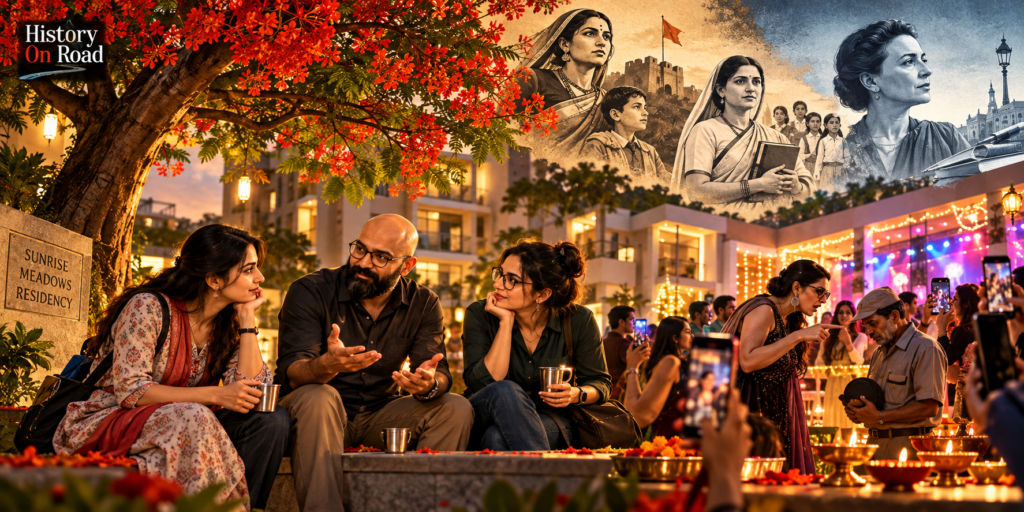
From the clubhouse came the thump of a DJ speaker. The society’s Diwali celebration had begun three hours earlier, and it showed no sign of ending.
“Another event, another dance floor,” Richa said, rubbing her temples. “Last month it was Karva Chauth. Before that, the housewarming. Before that, someone’s dog’s birthday.”
“People deserve joy,” Aditi said gently.
“They do,” Ganeshan said. “But joy and performance are different things. Look.”
Through the clubhouse window they could see forty residents, women and men alike, each holding a phone aloft. Nobody was watching the lamps being lit. They were watching the screens in which the lamps were being lit.
“When I was a child,” Ganeshan said, “my grandmother lit one diya and told us the story of why. Now we light two hundred diyas and tell nobody anything. We only film it.”
“It isn’t only the older generation who feels this,” Aditi said. “My cousin deleted her account last year. She said she couldn’t tell anymore whether she was happy or merely looked happy.”
“That’s the real cost,” Richa said. “Comparison. I see it at work too. A young colleague, brilliant girl, spent a week miserable because another colleague posted her holiday in Santorini. Nobody mentioned that the Santorini girl was drowning in credit card debt.”
“And the men?” Ganeshan asked with a half smile. “Do not let them off. The boys compare cars and salaries and gym photographs. The disease of display has no gender.”
Richa laughed. “Fair. I take it back. It’s an equal-opportunity disease.”
A shout rose from the lobby, and the three of them looked up.
Meenal Kapoor, a resident of Block C, was standing over the society’s housekeeping supervisor, a middle-aged man named Raghu, who held his cap in both hands. Her voice carried across the courtyard.
“I am an empowered woman! I set boundaries! You will not speak to me like that!”
Raghu had only asked, politely, whether she could keep her wet garbage separate from dry. A small crowd was filming.
Richa stood up, then sat down again. “I know exactly how this will go,” she said quietly. “She’ll tell everyone he was rude. Half the group chat will believe her without asking him.”
Aditi frowned. “That doesn’t sound like empowerment to me.”
“It isn’t,” Ganeshan said. “It is something older and uglier wearing a new coat. Power used without responsibility has always had one name: arrogance. Whether a king, a landlord or a loud neighbor wields it, the arrogance is the same. Only the vocabulary changes.”
“Explain,” Aditi said.
He set down his cup. “Words like boundaries, autonomy and empowerment were born in serious struggles. They carry the moral weight of people who truly suffered. But when someone borrows that weight to excuse cruelty to a poor man who cannot answer back, they have not used the word. They have stolen it. And every theft of that kind makes it harder for the genuinely wronged to be believed.”
Richa nodded slowly. “That worries me most. I have seen a real harassment case at my company, a woman who suffered badly and was brave enough to report it. Because of the noise around exaggerated complaints elsewhere, people looked at her with suspicion. She had to fight twice, once against the wrongdoer and once against the doubt that others had created.”
“Yes,” Ganeshan said. “Misuse of a protective law does double harm. It wrongs the innocent person accused, and it wounds the real victim who comes after. Anyone who truly cares for women should be angry at false claims, not defensive about them. Defending the weapon’s misuse is not loyalty to the cause. It is betrayal of it.”
“And the opposite is also true,” Aditi said carefully. “Some men use that argument as a shield to dismiss every woman who speaks up. Both abuses exist. I think we should refuse to be used by either.”
Ganeshan smiled warmly. “That is the wisest sentence spoken tonight.”
Raghu eventually walked away. Richa got up, crossed the courtyard and quietly asked him if he was all right. When she returned, her jaw was tight.
“Nobody else asked him,” she said.
“You did,” Aditi said.
“I did because my mother cleaned houses for twelve years,” Richa said. “I know what it is to be spoken down to by someone who has never earned respect, only inherited position.”
Ganeshan looked at her thoughtfully. “Then you already know what real empowerment looks like. It is not the right to dominate. It is the capacity to stand up and still treat the person beneath you as your equal.”
“Funny,” Aditi said. “My grandmother used to say something similar, and she never read a book on feminism in her life.”
“Many of the wisest women in our history never needed the word,” Ganeshan said. “Let me tell you about three of them.”
He leaned back, and the evening air seemed to settle around his voice.
“Jijabai raised a boy in a time of war and occupation. She did not teach Shivaji to hate. She taught him justice, protection of the weak, respect for every faith’s places of worship. Her strength was not displayed. It was built into another human being. Ask yourself: which of us today is building anyone?”
Aditi felt that question settle somewhere uncomfortable.
“Then Savitribai Phule. In 1848, she walked to a school she had helped found for girls in Pune, and people threw cow dung and stones at her. She carried a spare sari to change into when she arrived. Think about that. Hostile eyes, humiliation, and every day she went anyway. And remember, it was Jyotirao Phule, her husband, who first taught her to read and stood beside her in the work. She did not defeat men. She won over a society, men included, to a better idea. Her fight was against ignorance, not against a gender.”
“And Simone de Beauvoir?” Richa asked. “She’s usually the one people quote when they want to sound modern.”
“She is often quoted and rarely read,” Ganeshan said gently. “She wrote that one is not born, but becomes, a woman, meaning that society shapes roles, and that people of every gender deserve the freedom to shape themselves. But she also insisted that freedom carries responsibility, that we each must recognize the humanity of the other. Her relationship with Sartre, whatever you think of it, was a lifelong intellectual partnership, not a war. Nothing in her work says that women should become hard, vain or cruel. Anyone using her name to justify that has not finished the book.”
Aditi added quietly, “None of these three women ever said they did not need anyone.”
“No,” Ganeshan agreed. “Jijabai had her people, Savitribai had her husband and her friend Fatima Sheikh, and Beauvoir had her circle of thinkers. They stood strong, yes, but never in isolation. Strength was never the same as solitude.”
The music in the clubhouse changed to something louder. A group of residents spilled onto the lawn with a drum, and someone began a competitive dance, each person trying to out-shine the next.
“You know what bothers me?” Richa said. “I am not against celebration. My own childhood in Mysuru was full of festivals. But we celebrated with a purpose. The Dasara lamps meant something. Rangoli took hours and had patterns that carried geometry and meaning. We sang folk songs our grandmothers knew. Today I see people hiring an event manager to produce ‘authentic tradition’ for forty thousand rupees, and then eating pizza in the middle of it.”
“There is a danger there,” Ganeshan said. “When heritage becomes décor, it becomes the first thing we throw away. India carries thousands of years of art, music, food, medicine and philosophy. Every generation has the duty to hand it on slightly richer than it received it. That duty does not belong only to women or only to men. But in many homes, women were its quiet guardians, and that is exactly why their role has always been honored.”
“The kitty parties,” Aditi said, a little hesitantly. “I should say, my mother attends one. And honestly, I think they get an unfair reputation. Hers collects funds for a village school and organizes health camps.”
“Then hers is a good one,” Ganeshan said. “Any gathering is a mirror. If people come together to uplift someone, it is a community. If they come together to compare jewelry and gossip about those absent, it is a marketplace of envy. Same room, same tea, different purpose. And let us be fair, men’s clubs, cricket circles and office cliques fall into the same trap when they lose their purpose.”
Richa chuckled. “My husband’s poker evenings are an excellent case study.”
They all laughed, and the tension eased.
Around ten o’clock, the music finally lowered. Raghu appeared at the edge of the courtyard carrying a tray of cold drinks the society had asked him to deliver. Aditi stood up, took a glass from the tray and thanked him by name. Richa did the same. Ganeshan, already on his feet, shook his hand.
Raghu looked briefly startled, then smiled for the first time that evening.
“This,” Richa said as he left, “this is what I want us to do. Not post about kindness. Just do it.”
“A practical test, then,” Ganeshan said. “Whenever you consider an act or an idea described as empowering, ask three questions. Does it make me stronger without making someone else smaller? Would I accept it if it were done to me, or to my sister, or my son? And does it leave something better behind than I found?”
“Strength, fairness and legacy,” Aditi said. “I like that.”
“If an action fails those tests, it is not empowerment, whatever label it wears,” Ganeshan said. “It is simply self-interest dressed up in better clothes.”
Richa raised her cup. “To empowerment that carries responsibility.”
“To women and men,” Aditi added, “as two halves of one human story. Different in many ways, equal in dignity, and neither complete in shadows of the other.”
“To the gulmohar,” Ganeshan said, tilting his head toward the tree, “which gives shade to everyone beneath it without checking who they are.”
They clinked their steel cups gently. A single red petal fell into Aditi’s tea. She smiled, and left it there.
Behind them, the courtyard slowly emptied. In the clubhouse, someone finally switched off the speaker. For the first time that evening, the three friends could hear the quiet, and in the quiet, an idea older than any hashtag: that a society is judged not by how loudly it celebrates, but by how it treats the person who carries the tray.
Hashtags: #WomenEmpowerment, #ResponsibleFreedom, #SavitribaiPhule, #JijabaiLegacy, #IndianHeritage, #HistoryOnRoad
Category: Society & Culture / Social Commentary