

Loud Streets, Quiet Hearts: The Ganeshotsav We Forgot
A HistoryOnRoad story on reclaiming the joy, unity, and tradition of Maharashtra’s favourite festival
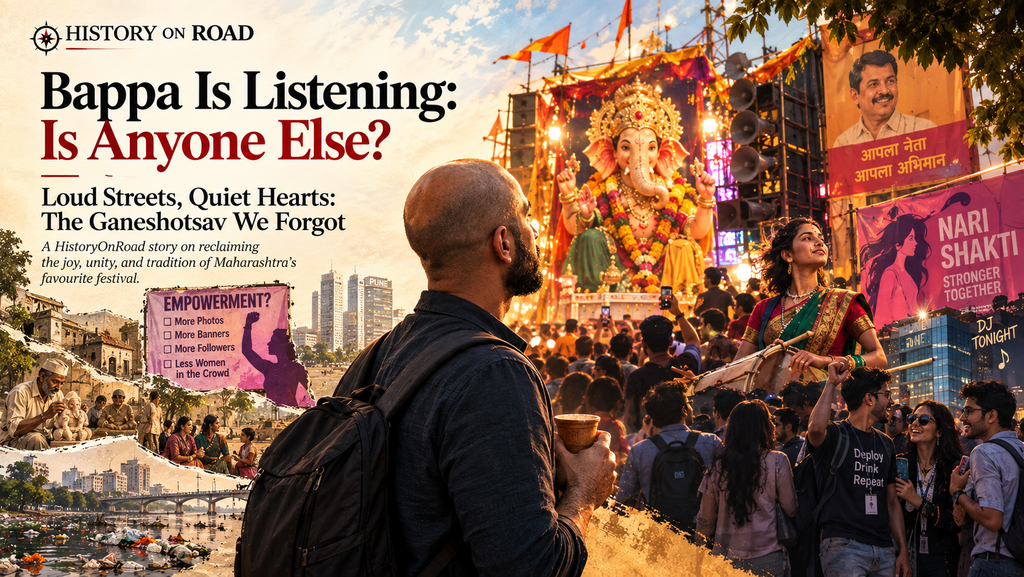
It is 11:40 at night on Neelkamal Road. The air smells of marigolds, hot bhajis, and diesel smoke. A tower of speakers shakes the shop shutters so hard that a row of steel glasses rattles on a tea stall. Between the bass and the crowd, a small girl presses her hands over her ears and hides behind her grandmother’s saree.
Ganesh stands at the edge of the road with a cold cup of tea. He is 35, a software engineer who travels every day to Tejwadi, the glass-tower district of Sahyanagar. Yes, he shares his name with the Lord whose festival he is watching. He has come to this road since he was a boy in short pants, holding his father’s finger.
Tonight his jaw is tight.
“I don’t mind the joy,” he says to nobody in particular. “I mind that a grandmother can’t hear her own prayer.”
Ganesh is not an angry man. He is a watchful one. What he sees tonight is something many people feel but few say aloud: the festival is getting louder, and the faith is getting quieter.
A City Running Faster Than Its Heartbeat
Sahyanagar is a city of sharp contrasts. Towers in Tejwadi glow at midnight while old wadas in Ratnapeth sleep under wooden balconies. Metro pillars stand where mango trees once gave shade. Students and young professionals arrive by the thousands from every corner of the country. Roads choke. One hour of rain turns a flyover into a river.
And the real rivers? The Nandini and the Kumud, once part of our grandmothers’ bedtime stories, now carry more plastic than prayer.
This is the city that welcomes Ganpati every year: proud, crowded, busy, and hungry for joy. Joy is not the problem. The problem begins when joy stops listening to everyone else.
A Boy, a Lane, and a Little Idol
When he was eight, his lane in Chandanpeth had a tiny mandal. Every neighbour gave twenty or fifty rupees, and receipts were written by hand. Uncles tied banana stems to bamboo poles. Aunties drew rangoli that lasted until the first rain. Children stole modak before the aarti. An old cassette player sang bhajans a little out of tune, and nobody minded.
Evenings belonged to everyone: a drawing contest, a quiz, a folk song night. His grandfather, Ajoba, sat on a plastic chair and told stories of old Maharashtra. Ajoba had one rule for every celebration: “Sing loud enough for Bappa, soft enough for your neighbour.”
Rich or poor, young or old, everyone stood shoulder to shoulder in the same small light.
“Ten days felt like ten weddings,” Ganesh says. “And every guest was family.”
What Ganesh Sees Tonight
Tonight the festival is bigger, brighter, and much faster. And Ganesh, who has kept quiet for years, has decided to look at it honestly.
A speaker as tall as a house points straight at the hospital gate. An old man there keeps his palm pressed to his heart. On a balcony above the tea stall, a student sits with open books, unable to study because the walls are shaking. A street dog runs in circles, unsure where to hide.
On the main stage, a group performs film numbers so crude that mothers tug their children’s hands and walk away. It might suit a nightclub. It does not suit a prayer. Nobody stops it, because nobody wants to speak first.
Then come the banners. Faces of organisers, twice as large as the Lord’s face, smile down from every pole. The idol has become a backdrop, and the aarti has become a photo shoot. Many people hold up phones to catch the perfect reel, and the Lord is seen only through a screen.
Ganesh feels a knot in his throat. He is not against fun. He loves a good dhol beat. He knows most of the crowd is simply happy, and happiness is loud. What he is against is a short list of behaviours:
- Speakers pointed at hospitals, schools, and the homes of elders.
- Using the festival to gain attention, power, or profit.
- Crude entertainment at a devotional event.
- Anything that pushes devotion aside for show.
“That is not culture,” he mutters. “That is noise wearing culture’s clothes.”
Enter Nomi, With Books and Questions
“You look like someone who lost his wallet and his smile on the same day,” says a familiar voice.
It is Nomi, his oldest friend. She is a historian and a social activist. She spends her weekdays in old archives and her weekends cleaning riverbanks with college kids. She hands him fresh chai and sits on the kerb.
“Say it,” she tells him. “You have been holding it in for years.”
“Fine.” Ganesh puts down his cup. “That speaker is aimed at a hospital. That stage is not a prayer. Those banners are not for Bappa. And everyone smiles and says nothing.”
“So why are you saying nothing too?”
“Because the moment I speak, someone says I am against tradition.”
“Are you?”
“No! I am against what is spoiling it.”
“Then say exactly that,” says Nomi. “Not against people. Against behaviour. And bring a fix along with the complaint. Do you know why this festival came out of our homes and onto the street?”
“To make it bigger?”
“To make it shared. Families used to pray inside their own homes. Then people realised a festival is sweeter when a whole lane celebrates together. Neighbours who barely knew each other sat, sang, and talked. The dhol was there from the start.”
“So the drums were always there.”
“Always. But their job was to call people closer. So ask of any sound, any stage, any banner: does it bring people together, or push them away?”
Behaviour Has No Birthplace
Ganesh sighs. “Sometimes I feel the whole city has changed. Too many newcomers, too many new habits.”
Nomi shakes her head. “Careful. Sahyanagar has always been a city of newcomers. The person who plays film songs at midnight and the person who never attends a lane meeting can both be born right here. I know engineers who play dhol at dawn. Behaviour has no birthplace, Ganesh. It has no job title, and it has no gender.”
“So the line is not between old and new.”
“The line is between people who think of their neighbour and people who don’t. It runs through every lane, every office, and sometimes through our own heart. When did you last attend a mandal meeting?”
“Five years ago.”
“Then that is where we begin,” Nomi smiles. “Complaining is easy. Turning up is the hard part.”
The Other Sahyanagar
“Come,” she says. “Before you decide the whole city is lost.”
They leave the main road and turn into a narrow lane in Ratnapeth. The thunder fades. In its place come the soft thud of a dhol and the clink of lezim.
An old idol maker, hands still grey with clay, is finishing a small shadu mati idol. “Clay comes from the earth and goes back to the earth,” he says. “Simple.” A mandal treasurer, tired but shining, shows Ganesh his notice board. Every rupee is written there for all to see. This year’s money is going to a free health camp, a children’s library, and two scholarships. There is no DJ. There are only teenagers who practised dhol and tasha for two months and now play with their whole hearts.
“Doesn’t anyone call you boring?” Ganesh asks.
The treasurer laughs. “Every year. Then they sit for ten minutes and forget to leave. We keep three rules: no speaker near the hospital, no film songs during the aarti, and every donation goes on the board. Simple rules. And more families find our lane each year.”
“There are so few lanes like this,” Ganesh says.
“Few, yes,” says Nomi. “But quiet devotion does not need a stage. It is like a banyan tree: slow, with deep roots.”
Dance, Devotion, and Real Respect
At the lane’s corner, a dhol-tasha troupe is warming up. Half the drummers are girls in green nauvari sarees, the other half are boys in kurtas, and all of them are sweating with concentration. Beside them, a group of teenagers practise lezim in perfect rows.
“Now I have to ask,” says Ganesh. “That main-road stage bothered me. The dancing there…”
“What exactly bothered you? The dancing, or what it was for?”
Ganesh thinks. “Not the dancing. Lezim is dancing, and I love it. It was the songs. They were crude, and they were meant to grab attention, not to honour Bappa. Mothers walked away with their children.”
“Then that is your answer,” says Nomi. “Dance is not the problem. Ask of any performance: would a grandmother and a grandchild both feel comfortable watching it? If yes, let it play. If no, a gentle request to change it is fair, whoever is on the stage.”
She nods towards the girls with the drums. “Those girls practised for two months. Nobody put their face on a banner. That is women’s strength: rehearsals, sweat, and skill. It doesn’t need a slogan.”
“And the boys beside them?”
“They carry the same drum. Real respect never makes one person smaller to make another bigger. A festival works when everyone stands in the same light.”
A Small Stage, a Big Moment
At the end of the lane stands a tiny stage. Children between eight and fourteen are performing a play about a village that shared one lamp. When the oil ran low, each family poured in a spoonful from its own bottle, and the light lasted all night. A boy playing the village elder has a cotton-wool beard that keeps slipping, and the audience laughs kindly every time.
The crowd is a beautiful mix: grandmothers, shopkeepers, delivery boys, and a young couple who arrived in the city a month ago and wandered in by chance. When the play ends, the whole lane claps, and the young couple clap the loudest. A grandmother offers them a plate of modak. “Come again tomorrow,” she says. “Bring friends.”
Something in Ganesh’s chest loosens.
“This,” he says, “is the festival I was looking for.”
“It was here all along,” says Nomi. “It was just standing a little away from the microphone.”
The Slow Part
Ganesh turns to the treasurer. “Do you need help with accounts? A website? Anything?”
The man blinks, then laughs in delight. “Ganesh-bhau, we have waited years for someone to ask. Come to our Sunday meeting.”
A lesser story would end here, with a cheering crowd. Real life is slower.
On Sunday, Ganesh attends his own lane’s meeting for the first time in five years. His hands are cold. He does not shout, and he does not accuse anyone. He says, “The big speaker faces the hospital. Can we turn it away and lower it? I will help with the arrangements.” A few elders nod. Two men study the floor. One says, “This is how it has always been done.” The meeting ends with no decision. The second week is much the same. In the third, a shy grandmother stands up and says she has not heard the aarti properly in three years. The room goes silent. That is what does it. The speaker is turned and lowered, “for a trial.” It is not a victory parade. It is the smallest turn of a tuning peg.
Ganesh and his office friends offer what they know best: digital receipts, eco-idol drives, river-cleaning weekends, and a quiet aarti hour every evening, with only voices and bells, so elders and babies can join in peace. Some mandals say yes at once. Some say, “Maybe next year.” Ganesh smiles at both. A lamp does not argue with the dark. It just keeps burning.
“Is it enough?” he asks Nomi.
“Enough for this year,” she says. “Next year, more. That is how every tradition has survived: one stubborn, gentle person at a time.”
What Every Family Can Do
Big change starts as a small habit. Here are simple steps for this year and every year after:
- Choose a clay idol and immerse it in a way that protects our rivers.
- Keep the volume kind near hospitals, schools, and elders.
- Attend one meeting in your own lane and offer a skill instead of just an opinion.
- Support mandals that serve, through health camps, libraries, and scholarships.
- Invite a newcomer to your aarti and share the story behind it.
- Teach a child one shlok, one folk song, and one story of old Maharashtra.
- Put the phone down for one minute during the aarti and simply be there.
The HistoryOnRoad Perspective
At HistoryOnRoad, we walk the lanes of Maharashtra with one belief: history is not a dead thing in a museum. It is a living road, and we are all walking on it.
Our Ganeshotsav was born from togetherness. It was meant to turn a stranger into a neighbour and a neighbour into family. Today the city is bigger and busier, and the festival has grown with it. Every festival is exactly as good as the people who show up for it. If we show up only to watch, we get a show. If we show up to serve, sing, and share, we get a festival.
So we name behaviours, not people. Loud speakers near a hospital, a prayer turned into publicity, and a stage that would embarrass a child are things we can gently refuse, together, without anger.
“A festival where every woman, man, and child feels safe, respected, and free to celebrate with devotion is a festival worth protecting.”
The engineer in Tejwadi, the student from far away, the grandmother in Ratnapeth, the girl with the dhol, and the old idol maker with clay-stained fingers all belong to one story. Our task is not to push anyone out. It is to invite everyone in, with a lamp in one hand and a smile on the face.
Maharashtra’s tradition is rich, but it is not fragile. It has welcomed many people and many centuries, and it has always found a way to stay warm. What it needs now is care: warm hands, steady voices, and a little patience.
So put humanity first. Be kind to the elder who needs quiet, the child who needs joy, and the newcomer who needs a welcome. Bring the old songs back. Keep the river clean. Let the dhol call people together, as it always did. When we do this, Ganpati Bappa does not need a big sound system to be heard. He is already listening.
“Ganpati Bappa Morya. Pudhchya Varshi Lavkar Ya.“
All names, places, and characters in this story are fictional. It is written to spread good vibes, respect for every person, and pride in Maharashtra’s living traditions.

Borrowed Glory in Kalikapur: The Story of a Village Election