

How a broken bowl became a symbol of resilience worth understanding today.
Somewhere in fifteenth-century Japan, a shogun is said to have sent a damaged tea bowl back to China for repair. When it returned, mended with ugly metal staples, the story goes that Japanese craftsmen set out to find a more graceful solution of their own.
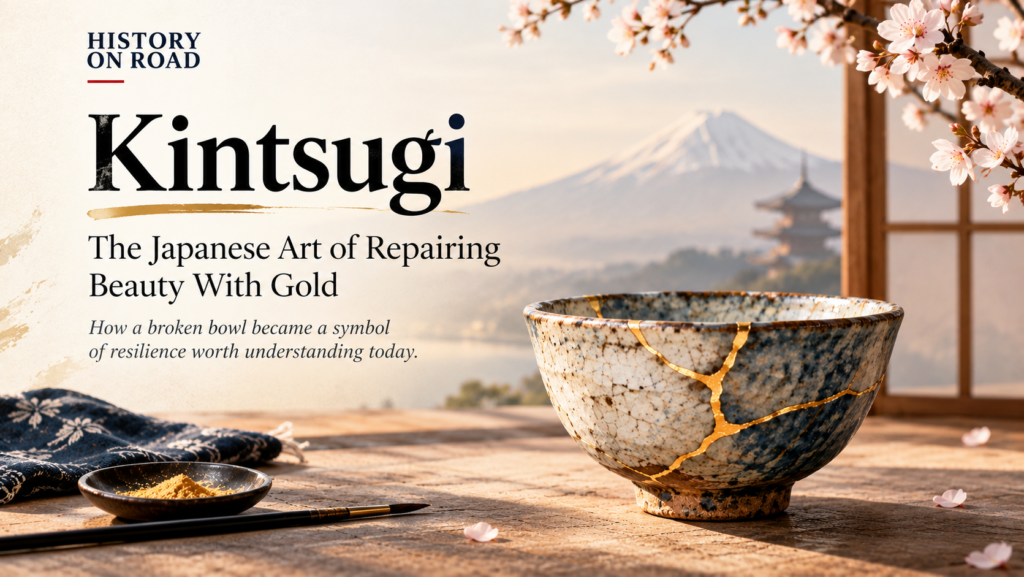
What emerged became one of the most quietly profound art forms in Japanese history: kintsugi, the practice of repairing broken pottery with lacquer mixed with gold, silver, or platinum, turning the cracks that once meant damage into something deliberately visible and deliberately beautiful.
This is the story of kintsugi — how it works, the philosophy that shaped it, and why a centuries-old approach to broken objects has found renewed relevance in 2026.
What kintsugi actually involves
The word kintsugi translates roughly to “golden joinery,” and the technique lives up to the name. When pottery breaks — a treasured tea bowl, a plate, a vase — the traditional response in many cultures has been to discard the object or repair it as invisibly as possible, hiding the damage until no trace remains.
Kintsugi does the opposite. Artisans rejoin the fragments using urushi, a natural lacquer drawn from the sap of the lacquer tree and used in Japanese craftsmanship for centuries. Once the pieces are secure, the seams along the fracture lines are dusted or painted with fine gold powder — sometimes silver or platinum — creating a luminous network of repaired cracks across the surface.
The damage becomes the most distinctive feature of the piece. A bowl repaired this way does not pretend it was never broken. It displays its history openly, and often ends up more striking, and more highly valued, than it was before.
The philosophy behind the practice
Kintsugi did not emerge in isolation. It developed within a wider Japanese aesthetic tradition associated with wabi-sabi, a worldview that finds beauty in imperfection, impermanence, and the honest signs of age and wear. Where many artistic traditions prized flawless symmetry and pristine surfaces, wabi-sabi held that authenticity — the visible marks of a life fully lived — carries its own meaningful beauty.
Kintsugi extends that idea into the physical act of repair. A mended object is not treated as lesser than it was before. It has simply continued its story, carrying evidence of both damage and care in the same body. The gold seams do not disguise the fracture. They honour it, marking the break as part of the object’s history rather than something to erase.
The message about resilience is implicit but powerful. Breakage is not the end of an object’s value. It is one chapter in a longer story — one that, with patience and skill, can lead somewhere more distinctive than where it began.
Kintsugi as a metaphor for human experience
Though it began as a ceramic technique, kintsugi has grown in recent decades into a widely used metaphor for resilience, emotional healing, and growth after hardship. The comparison lands easily. Just as a repaired bowl becomes more striking rather than less valuable, many people find meaning in the idea that grief, setbacks, and painful experiences — once processed and integrated rather than hidden — can become an honoured part of who someone is, not a flaw to conceal.
This has resonated especially in conversations about mental health, where the instinct to present only a polished, unbroken exterior is being actively questioned. Kintsugi offers an alternative: openness about past difficulty treated not as weakness, but as a meaningful part of a fuller and more honest story.
Why kintsugi matters in 2026
Conversations about mental health, burnout, resilience, and authenticity have moved firmly into mainstream discussion — in workplaces, schools, families, and online. Kintsugi gives those conversations a usable frame, translating an abstract idea into something tangible and visual.
The relevance runs deeper than metaphor. Modern life places enormous pressure on the appearance of constant success and curated presentation, amplified by platforms that reward polished images of a life over complete ones. Kintsugi is a centuries-old counterpoint: visible evidence of struggle, properly cared for, does not diminish worth. It can become the source of it.
There is an environmental dimension too. In a culture still oriented around disposability, where damaged objects are replaced rather than repaired, kintsugi represents a sustainable philosophy of care, patience, and long-term value. Choosing to repair — and doing so with skill and intention rather than treating repair as a compromise — aligns closely with movements around sustainable consumption, the right to repair, and reducing waste.
Finally, kintsugi offers a lesson in how we handle failure. In an era that often moves quickly to bury mistakes and setbacks rather than examine them, the kintsugi philosophy suggests a healthier alternative: failure, once addressed thoughtfully, becomes a visible and valuable part of the record rather than something pretended away.
The craftsmanship behind the symbolism
Kintsugi is known mostly for what it symbolises, but the technical skill it demands deserves attention. Traditional repair is a specialised craft, usually requiring years of training to perform to a high standard. Artisans assess how fragments fit together — sometimes reconstructing a piece from multiple separate fractures — and apply urushi lacquer in controlled layers, each needing its own curing period before the next stage can begin.
Applying the metal powder along the finished seams takes similar care, so the finish sits evenly and durably without compromising the structure underneath. A well-executed repair can return an object to genuine use, capable of holding liquid and withstanding regular handling rather than serving as a display piece. That combination of structural repair and deliberate aesthetic transformation is what separates traditional kintsugi from the simpler decorative imitations that have appeared more recently around the world.
Kintsugi and the Japanese relationship with objects
Kintsugi reflects a broader attitude found across traditional Japanese craft: a preference for long relationships with well-made objects over frequent replacement. Households historically maintained and repeatedly repaired treasured things — ceramics, textiles, furniture — across generations, treating careful repair as a natural part of an object’s life rather than a burdensome exception.
That context explains why kintsugi developed the philosophy it did, treating repair not as an unfortunate necessity to be hidden but as a celebrated continuation of an object’s story. It reflects a genuinely different relationship between people and their possessions than the replacement-oriented consumer culture dominant in much of the modern world — and that contrast is exactly where kintsugi’s renewed relevance comes from.
A practice that requires patience
Traditional kintsugi is not quick. The natural lacquer needs significant time to cure, often weeks between stages of a single repair. That patience is part of the meaning. Meaningful repair — of an object, or by extension of a person after hardship — is rarely instantaneous. It requires sustained care, the right conditions, and enough time for healing to take hold, rather than a rushed fix applied to restore the appearance of normalcy.
Applying the kintsugi mindset beyond pottery
The underlying mindset offers guidance well beyond broken bowls. Organisations increasingly see the value of honest reviews after significant failures rather than quietly moving on. Individuals facing career disappointments, relationship difficulties, or health challenges often find real value in approaches to healing that acknowledge and integrate hard experiences into a fuller personal story, rather than trying to step past them as though they never happened.
None of this suggests hardship should be sought out or celebrated. It suggests that once hardship has occurred — as it inevitably will across any long personal or organisational history — the most sustainable response tends to involve honest acknowledgment and thoughtful integration rather than concealment. The gold seams of a kintsugi bowl do not glorify the break. They simply refuse to pretend it never happened.
The Historyonroad perspective
Kintsugi is exactly the kind of story we believe deserves wider attention: a centuries-old craft tradition that speaks directly to some of the most pressing emotional and cultural conversations of 2026. It would be easy to admire it as a beautiful decorative technique and set it aside. We think it deserves more than that.
In a world still learning how to talk honestly about struggle, failure, and recovery, a Japanese art form built around the radical idea that broken things can become more valuable rather than less offers a genuinely useful framework. That, to us, is history doing what it does best — offering guidance for the present, drawn quietly from the wisdom of the past.