

How a Three Thousand Year Old Irrigation Method Still Offers Answers to a Thirsty Modern World
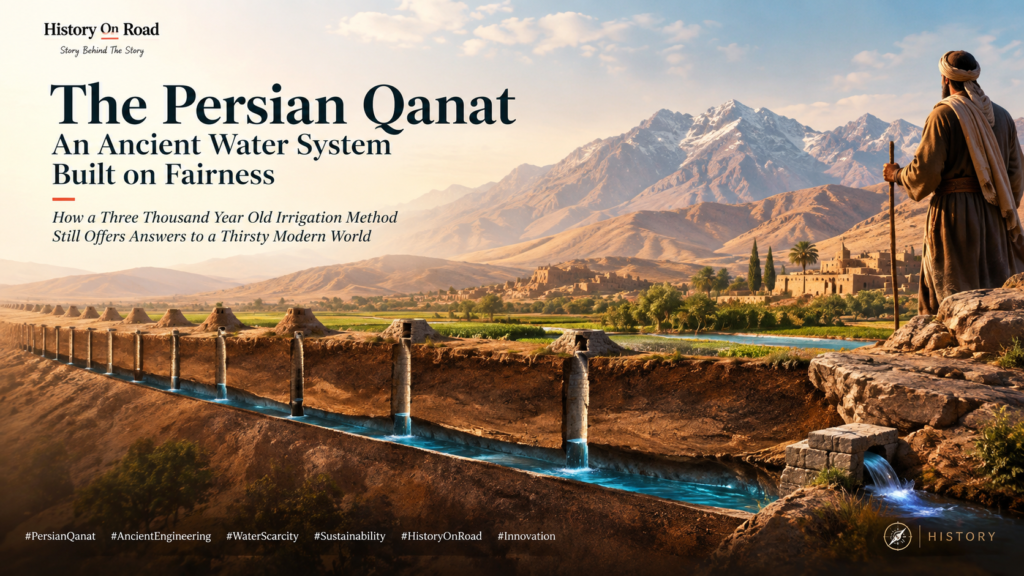
In the dry, arid landscapes of ancient Persia, where reliable rainfall was scarce and rivers were often distant, survival depended on solving one of the most fundamental engineering challenges a civilization can face, how to deliver clean, reliable water across long distances without losing most of it to evaporation along the way. The solution that emerged, known as the qanat system, remains one of the most impressive and enduring pieces of ancient infrastructure ever developed, some qanats still functioning today after more than two thousand years of continuous use. This is the story of how the qanat works, the community values built directly into its design, and why this ancient system carries genuinely urgent relevance for a world increasingly confronting serious water scarcity in 2026.
Engineering Water From Underground
A qanat is, at its core, a gently sloping underground tunnel, dug by hand across long distances, designed to carry groundwater from an elevated source, often located at the base of nearby mountains or hills, down toward lower lying agricultural land and settlements, using gravity alone rather than any mechanical pumping system. Builders would first locate an accessible source of groundwater, then dig a nearly level tunnel, sloped with extraordinary precision, extending sometimes for many kilometers, from that source toward the communities that needed reliable access to water.
Along the length of the tunnel, workers dug a series of vertical shafts at regular intervals, serving both as access points for construction and ongoing maintenance, and as ventilation openings allowing air to circulate through the underground channel. From above ground, a completed qanat often appears as a distinctive line of small, evenly spaced mounds stretching across the landscape, each one marking the location of a vertical access shaft leading down to the main tunnel below.
By carrying water underground rather than through open surface channels, qanats dramatically reduced water loss due to evaporation, an enormous advantage in the hot, arid climate where the system originated. This underground design also helped protect the water supply from contamination and reduced losses that might otherwise occur through surface based irrigation methods in a similarly dry environment.
An Engineering Achievement Built Without Modern Tools
What makes the qanat system particularly remarkable is the level of precision required to build it successfully using only ancient tools and techniques. Builders needed to calculate and maintain an extremely gentle, consistent downward slope across sometimes many kilometers of underground tunnel, steep enough to keep water flowing steadily by gravity alone, but gentle enough to prevent the flow from becoming so fast that it eroded the tunnel walls or created damaging turbulence. Achieving this balance across long distances, entirely underground, without the benefit of modern surveying equipment, represents a genuinely impressive feat of applied mathematics, hydrology, and engineering skill developed and refined by Persian engineers roughly three thousand years ago.
Beyond the technical achievement itself, qanat construction required enormous, sustained community labor and long term planning. Building a single qanat could take years, sometimes even generations, to complete, and required specialized, skilled workers known as muqannis, who passed detailed technical knowledge down through generations of practice, developing a highly specialized craft tradition dedicated entirely to the construction and ongoing maintenance of these underground water systems.
Fairness Built Directly Into the System
Perhaps the most socially significant aspect of the qanat system was how thoroughly questions of fair water distribution were addressed directly within its design and governance. Because a single qanat often supplied water to multiple households, farms, and even entire villages, clear, established systems were developed to ensure water access was distributed fairly among all who depended on a shared qanat, rather than allowing whoever lived closest to the source, or whoever held the most immediate power, to simply take as much as they wished.
Many qanat systems operated under detailed customary or legal arrangements specifying exactly how much water each household or landholder was entitled to receive, often based on factors like land size or historical water rights, with designated community members responsible for overseeing fair distribution and resolving disputes when they inevitably arose. Some regions developed rotating schedules determining which farms received water access on which specific days, ensuring that during periods of especially limited supply, the burden of scarcity was shared fairly across the entire community rather than falling disproportionately on those with the least social or political influence.
This built in emphasis on fairness reflects a broader recognition, developed and refined over centuries of practical experience, that shared, limited resources require thoughtful, deliberate systems of governance to remain sustainable and to avoid the kind of destructive, unregulated competition that can otherwise deplete a resource entirely or generate ongoing, damaging social conflict within a community.
Remarkable Longevity
Many qanats built centuries, and in some documented cases, well over two thousand years ago, remain in active use today, particularly across Iran, though similar systems developed independently or through cultural exchange can be found across parts of the Middle East, North Africa, and even reaching as far as Spain and parts of Latin America through historical trade and migration connections. Their continued functionality after so many centuries stands as powerful testimony to both the technical soundness of the original engineering and the sustainability of the community governance systems developed to manage and maintain them over such extraordinarily long periods of time.
Why the Qanat Matters in 2026
In 2026, water scarcity has become one of the defining environmental and humanitarian challenges facing communities across the globe, driven by a combination of climate change, population growth, and increasingly unsustainable patterns of water consumption and management in many regions. Against this urgent backdrop, the ancient qanat system offers genuinely valuable lessons, both technical and social, that extend well beyond simple historical interest.
On a purely technical level, the qanat’s fundamental approach, minimizing water loss through evaporation by transporting it underground and relying on gravity rather than energy intensive pumping systems, aligns closely with modern priorities around sustainable, low energy water infrastructure, particularly relevant in regions facing both water scarcity and limited access to reliable energy resources. Some modern water engineers and sustainability researchers have specifically studied traditional qanat systems for insights applicable to contemporary water management challenges in arid and semi arid regions around the world.
Just as significantly, the fairness focused governance systems historically built around qanat water distribution offer a valuable, tested model for addressing modern water allocation disputes, an increasingly common and serious source of conflict in numerous regions worldwide as available water resources come under growing pressure. The qanat tradition demonstrates that shared, limited resources can be managed sustainably and equitably over extraordinarily long periods of time, provided that clear, fair, consistently enforced systems of governance are established and genuinely respected by the community relying on them.
There is also a broader lesson here about long term thinking and community investment. Qanat systems were built with the explicit understanding that they would serve not just the generation that constructed them, but many generations to come, requiring ongoing, shared maintenance and collective responsibility to remain functional over time. This long term, community oriented approach to shared infrastructure stands as a valuable contrast to more short term, individually focused approaches to resource management that too often dominate modern decision making, particularly around water and other increasingly strained natural resources.
Spreading Across Continents
While the qanat system originated in ancient Persia, likely emerging sometime around the first millennium BC, the technology and its associated knowledge spread significantly over subsequent centuries, carried through trade routes, conquest, and cultural exchange across a remarkably wide geographic area. Similar underground water systems appeared across the Middle East, North Africa, and eventually reached as far as southern Spain following the period of Islamic rule on the Iberian Peninsula, where the technology became known locally as galerias or minas de agua.
Spanish colonizers and settlers later carried related irrigation knowledge across the Atlantic, and comparable underground water systems can still be found in parts of Latin America, including regions of Mexico and Peru, illustrating just how far this originally Persian innovation eventually traveled through centuries of migration, trade, and cultural exchange. This widespread geographic adoption speaks to the qanat’s genuine practical effectiveness, a technology valuable enough to be actively sought out, adapted, and implemented by numerous different cultures facing similar underlying challenges of water scarcity in arid and semi arid environments, regardless of their specific political or religious context.
Today, the qanat tradition holds significant cultural and historical recognition, with several qanat systems in Iran formally recognized as UNESCO World Heritage sites, acknowledging both their remarkable engineering achievement and their continued cultural and practical significance to communities that still rely on them.
The Human Cost of Building Underground
It is worth acknowledging that constructing a qanat was genuinely dangerous, difficult work, carried out by skilled laborers digging and maintaining narrow underground tunnels, often at considerable personal risk from collapse, poor air quality, or flooding. The specialized muqanni craft tradition carried real professional prestige precisely because of the significant skill and courage the work demanded, and historical accounts suggest that experienced muqannis were highly valued and respected members of their communities, entrusted with maintaining infrastructure upon which entire settlements directly depended for their continued survival.
This human dimension of the qanat story is worth remembering alongside its impressive engineering and governance achievements. The system’s remarkable longevity was not simply a matter of clever design. It depended equally on generations of skilled workers willing to take on genuinely dangerous labor, and on communities willing to properly value, train, and compensate that labor over the long term. Modern infrastructure planning, similarly, depends heavily on skilled labor that is too often undervalued or under compensated relative to its genuine importance, a parallel worth keeping in mind when considering how modern societies invest in and support the workers responsible for maintaining critical, often invisible, infrastructure systems today.
The Historyonroad Perspective
At Historyonroad, the story of the Persian qanat reflects exactly the kind of ancient wisdom we believe deserves far greater modern attention, a practical, tested solution to a challenge, water scarcity and fair resource sharing, that has become dramatically more urgent, not less, in the centuries since the qanat was first developed. It would be easy to view this system as simply an impressive but outdated piece of ancient engineering. We believe it deserves to be studied seriously, both for its genuine technical ingenuity and for the fairness minded governance principles built directly into its long term success. In a world of 2026 facing serious, growing water challenges across many regions, the quiet, patient wisdom of a three thousand year old underground water system feels less like a historical footnote, and more like a genuinely useful guide worth taking seriously today.



Borrowed Glory in Kalikapur: The Story of a Village Election