

How a Simple Inscribed Phrase Became a Timeless Tool for Emotional Balance
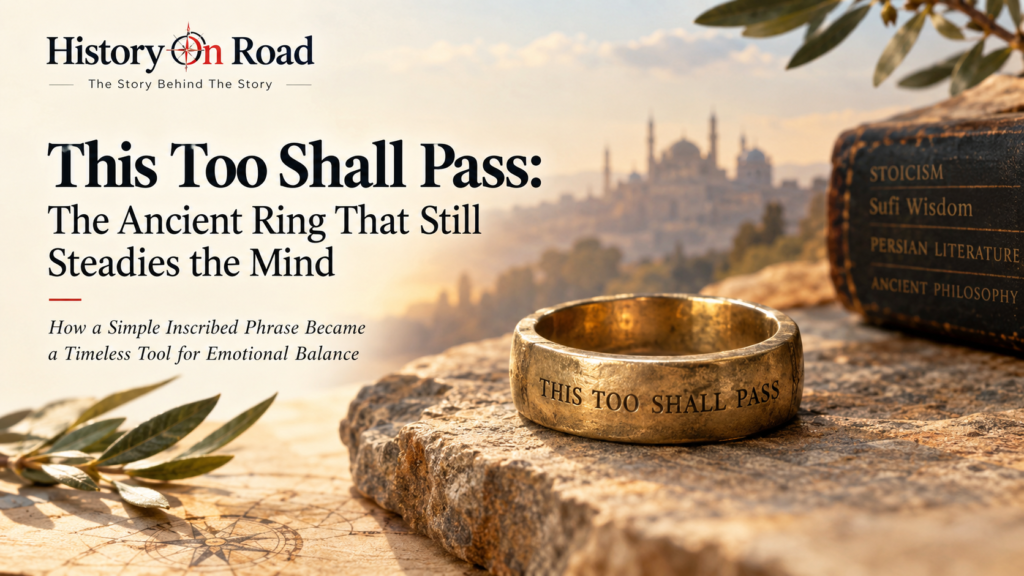
Among the many stories passed down from ancient philosophical traditions, few carry the quiet, practical power of the tale of a ring engraved with a simple phrase, meant to remind its wearer of one steady truth applicable to both triumph and hardship alike, that all things, whether joyful or painful, eventually pass. Often associated with wisdom traditions connected to both ancient Persian and later Sufi and biblical storytelling, and closely aligned with the philosophical outlook of Stoicism developed in ancient Greece and Rome, this simple object and its accompanying phrase have traveled across centuries and cultures, offering a remarkably consistent and enduring form of emotional guidance. Understanding the story behind this ring, and the philosophy it represents, reveals why such a small, humble object continues to resonate so strongly with the emotional challenges of life in 2026.
The Legend of the Ring
The most widely known version of this story involves a king, sometimes identified in various retellings as King Solomon, who is said to have requested from his advisors an object that would make him happy when he was sad, and humble when he was happy, something capable of grounding him equally during both extremes of emotional experience. After considerable thought, his advisors are said to have presented him with a simple ring, engraved with the phrase, this too shall pass.
The wisdom embedded in this small object lies precisely in its dual application. During moments of hardship, grief, or difficulty, the phrase offers genuine comfort, a reminder that pain, however overwhelming it may feel in the moment, is not a permanent condition, but a temporary state that will eventually shift and ease. Yet the same phrase, applied during moments of triumph, success, or pleasure, offers an equally important reminder of humility, that success and good fortune are similarly temporary, and should be appreciated fully without becoming a source of arrogance or complacency, precisely because they too will inevitably change.
This dual function, offering both comfort during hardship and humility during success, is what elevates the story beyond a simple message of optimism. It reflects a more complete, balanced philosophical outlook, one focused not on denying the reality of either suffering or joy, but on maintaining a steady, grounded emotional perspective through both.
Stoicism and the Philosophy of Impermanence
While the specific legend of the ring draws from various cultural and religious traditions, its underlying philosophy aligns closely with Stoicism, a school of thought developed in ancient Greece and later significantly expanded by Roman philosophers, several of whom, including Marcus Aurelius, Seneca, and Epictetus, wrote extensively about the value of accepting impermanence and focusing one’s energy only on what genuinely lies within a person’s control.
Stoic philosophy places significant emphasis on the idea that emotional suffering often arises not directly from external events themselves, but from a person’s internal judgments and expectations regarding those events, particularly the mistaken belief that certain conditions, whether comfort, success, or the absence of hardship, should or will remain permanent. By training oneself to genuinely internalize the temporary, ever changing nature of all circumstances, Stoic philosophy suggests, a person can develop significantly greater emotional resilience, neither collapsing entirely under hardship nor becoming dangerously overconfident during periods of success.
The ring, and its simple engraved phrase, functions essentially as a physical, wearable reminder of this deeper philosophical practice, offering a small, constant, tangible prompt encouraging its wearer to maintain perspective and emotional balance regardless of momentary circumstances.
Why a Physical Object Matters
There is real, practical value in the fact that this wisdom was traditionally embodied in a physical object rather than simply expressed as an abstract idea or written teaching. A ring, worn continuously and visible throughout each day, offers a consistent, low effort reminder that does not require deliberate, ongoing mental effort to recall. Philosophy expressed only through occasional reading or reflection can easily fade from active attention during moments of genuine emotional intensity, precisely when it is needed most. A physical object, integrated directly into daily life, offers a considerably more reliable and consistent form of reinforcement.
This insight, that meaningful ideas benefit significantly from physical, tangible reinforcement rather than existing purely as abstract mental concepts, reflects a broader and genuinely valuable principle found across many ancient wisdom traditions, one increasingly supported by modern psychological research into habit formation and behavioral reinforcement as well.
Balance Rather Than Detachment
It is worth clarifying an important distinction within this philosophy, one sometimes misunderstood in popular, simplified retellings of Stoic thought. The message of the ring, and the broader philosophy it reflects, does not encourage emotional detachment or the suppression of genuine feeling during either hardship or joy. It encourages instead a grounded, honest awareness of impermanence that allows emotion to be fully experienced without becoming overwhelming or distorted by the mistaken belief that current circumstances represent a permanent, unchangeable state.
A person who has genuinely internalized this wisdom can still grieve fully during loss, still celebrate genuinely during success, and still feel the complete range of human emotion as circumstances warrant. What changes is the underlying framework surrounding that emotional experience, an awareness that holds space for both feeling and perspective simultaneously, rather than requiring one to suppress or diminish the other.
This balanced approach, feeling fully while maintaining grounded perspective, represents a considerably more sophisticated and genuinely useful form of emotional wisdom than either extreme, unchecked emotional reactivity on one end, or cold, detached suppression on the other.
Why This Matters in 2026
In 2026, emotional regulation, resilience, and mental health have become subjects of widespread public conversation and genuine concern, discussed openly across workplaces, schools, healthcare systems, and personal relationships in ways that would have seemed far less common even a generation ago. Amid this ongoing conversation, the ancient wisdom embedded in the story of this ring offers a genuinely useful, accessible framework, one that avoids both the trap of toxic positivity, pretending hardship does not exist or should be minimized, and the equally unhelpful trap of catastrophizing, treating temporary difficulty as though it represents a permanent, unchangeable state.
The specific message of impermanence carries particular relevance given the intensity and immediacy of modern digital life. Social media and constant connectivity often amplify both emotional highs and emotional lows considerably, creating an environment where momentary setbacks or triumphs can feel disproportionately permanent and significant, whether through the public, lasting nature of digital criticism and conflict, or through the pressure to maintain a continuously successful, polished public image. The reminder that both circumstances will pass offers a valuable corrective to this intensified, often distorted emotional landscape.
There is also significant relevance in the ring’s message of humility during success, a lesson that feels particularly important in a culture that frequently celebrates achievement, status, and visible success as ends in themselves, sometimes without sufficient attention to the reality that such circumstances remain inherently temporary and should be held with appropriate perspective and gratitude rather than complacent entitlement.
Additionally, growing modern interest in mindfulness practices, many of which similarly emphasize the impermanent, ever changing nature of thoughts, emotions, and circumstances, reflects essentially the same underlying wisdom embedded in this ancient ring, expressed through different, though closely related, philosophical and psychological frameworks. The renewed popularity of Stoic philosophy itself in recent years, reflected in numerous modern books, workshops, and online communities dedicated to studying and applying Stoic principles to contemporary life, further underscores just how directly relevant this ancient wisdom remains to genuinely modern struggles around anxiety, emotional regulation, and maintaining perspective amid constant change.
A Practice, Not Just a Phrase
It is worth noting that the value of this ancient wisdom lies not simply in reciting the phrase itself during difficult or joyful moments, but in genuinely internalizing and practicing the underlying perspective it represents, consistently, over time. Like most meaningful philosophical or psychological practices, its real benefit comes through repeated, sustained application, gradually training a more balanced, resilient emotional response, rather than through a single moment of intellectual recognition alone.
Echoes Across Different Traditions
What makes the story of this ring particularly compelling is how consistently its central message appears across otherwise distinct religious, philosophical, and cultural traditions, suggesting the underlying insight reflects something close to a universal human observation rather than a single culturally specific teaching. Versions of the story and its core message appear in Jewish folklore, various strands of Sufi poetry and teaching within the Islamic tradition, and Persian literary sources, in addition to its close philosophical alignment with Stoic thought developed independently within the Greco Roman tradition.
This kind of convergence, where distinct cultures separated by significant geography and time arrive independently at closely related conclusions about how to maintain emotional balance amid life’s inevitable changes, lends the underlying insight considerable additional weight. It suggests the wisdom embedded in the ring’s simple inscription reflects something close to a genuinely universal observation about human emotional experience, rather than a narrow teaching relevant only within one specific cultural or religious context. This universality is likely part of why the story has continued to resonate so broadly and has been retold, adapted, and referenced across so many different literary and philosophical traditions throughout history, remaining recognizable and meaningful regardless of the specific cultural lens through which it is encountered.
Practicing the Philosophy, Not Just Admiring It
There is a meaningful difference between finding the story of this ring pleasant or interesting, and actually applying its underlying philosophy in daily life, particularly during moments of genuine emotional intensity when such perspective is often hardest to access. Stoic philosophers themselves were quite explicit about this distinction, emphasizing repeatedly throughout their surviving writings that philosophy held little genuine value unless actively practiced and applied, rather than simply studied or admired intellectually from a comfortable distance.
Modern approaches to building this kind of practical emotional resilience often draw on similar underlying principles, encouraging regular, deliberate reflection on the temporary nature of both difficulty and success, rather than relying on a single moment of insight to produce lasting change. Journaling practices focused on gratitude and perspective, structured reflection during particularly difficult or particularly triumphant moments, and mindfulness practices emphasizing the transient nature of thoughts and emotions all represent modern, practical methods for building the same kind of steady, grounded resilience that an ancient ring, engraved with four simple words, was originally designed to encourage through nothing more than its constant, quiet presence on a wearer’s hand.
The Historyonroad Perspective
At Historyonroad, the story of this ancient ring exemplifies precisely the kind of simple, accessible wisdom we most value sharing with our readers, a lesson requiring no complicated explanation or specialized knowledge to understand, yet carrying genuinely profound, practical value for daily life. It would be easy to treat this story as simply a pleasant, comforting piece of ancient folklore. We think it deserves to be treated as something closer to a genuinely useful emotional tool, directly applicable to the anxiety, pressure, and constant emotional intensity many people experience in 2026. Sometimes the most valuable guidance available to us is not new at all. It has simply been waiting, quietly engraved on a small ring, for as long as humanity has needed reminding that everything, without exception, eventually passes.
Category: Philosophy & Wisdom (Ancient Traditions)
Hashtags: #ThisTooShallPass, #Stoicism, #AncientWisdom, #EmotionalResilience, #MindsetMatters, #Historyonroad