
Why a Simple Frame of Beads Remains Relevant in an Age of Advanced Computing
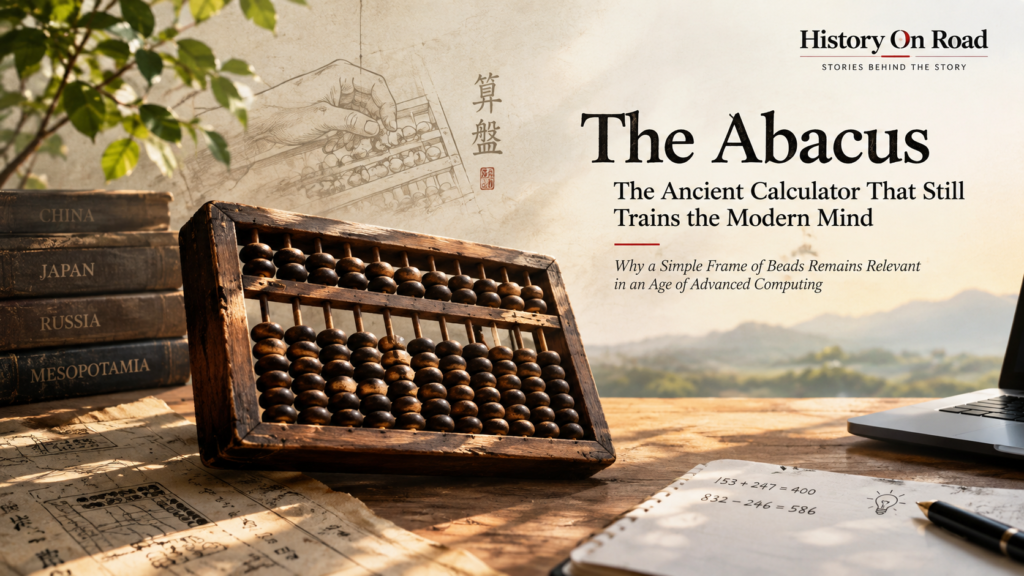
Long before calculators, computers, or smartphones capable of solving complex equations in an instant, humans relied on a remarkably simple, elegant tool to perform arithmetic, the abacus. Consisting typically of a wooden or metal frame holding a series of rods or wires, each strung with movable beads, the abacus allowed users to perform addition, subtraction, multiplication, and even division through a structured, physical system of counting. Developed independently across several ancient civilizations and refined over thousands of years, the abacus remains, remarkably, in active use and instructional practice today, even in a world dominated by digital technology. This is the story of how the abacus works, why it endured for so long, and why it continues to hold genuine educational and cognitive value in 2026.
An Ancient Tool With Independent Origins
The exact origins of the abacus are difficult to pin down precisely, in large part because similar counting tools developed independently across multiple ancient civilizations, each adapting the basic concept to their own numerical systems and practical needs. Early counting boards, using loose stones or markers moved across grooved surfaces or marked lines, appeared in ancient Mesopotamia and later in ancient Greece and Rome. The more structured, bead based abacus design familiar today developed further in ancient China, where it became known as the suanpan, and later spread to Japan, where a refined version known as the soroban became particularly widespread, and to Russia, where a distinct version known as the schoty developed its own unique structure.
Despite regional variations in design, the fundamental principle behind the abacus remained remarkably consistent across these different traditions, using the physical position of movable beads along fixed rods to represent numerical values, allowing users to perform calculations through structured, repeatable physical movements rather than relying purely on mental arithmetic or written calculation.
How the Abacus Actually Works
At its core, an abacus represents numbers through place value, similar to the modern decimal system, with different rods representing different place values, ones, tens, hundreds, and so forth. Beads are moved toward or away from a central bar or fixed reference point to represent specific digits within each place value, and skilled users learn structured, systematic techniques for combining, carrying, and adjusting these bead positions to perform addition, subtraction, multiplication, and division accurately and, with sufficient practice, remarkably quickly.
What makes the abacus particularly powerful as a calculation tool is not simply its mechanical function, but the way sustained practice with it trains a user’s mental processing of numbers more broadly. Experienced abacus users often develop the ability to perform accurate mental calculations even without a physical abacus present, visualizing the movement of beads mentally, a skill sometimes referred to as mental abacus calculation, demonstrating just how deeply the physical practice can become internalized as a genuine cognitive skill extending well beyond the physical tool itself.
A Tool That Survived the Calculator
Given the abacus’s ancient origins, it might seem reasonable to assume the device became entirely obsolete following the development of modern electronic calculators and computers. In practice, the abacus has proven remarkably resilient, remaining in active practical use in various parts of the world, and experiencing significant renewed interest as an educational tool specifically because of, rather than despite, the widespread availability of digital calculating devices.
In several countries, particularly across parts of Asia, structured abacus instruction remains a common and valued component of early childhood mathematics education, valued not because the abacus calculates more efficiently than a modern digital calculator, which it certainly does not, but because the physical, structured process of learning to use it effectively appears to offer genuine, measurable cognitive benefits, particularly for young children developing foundational numerical understanding and mental calculation skills.
Why the Abacus Still Matters for Learning
Educational researchers studying abacus based instruction have identified several specific cognitive benefits associated with sustained practice, particularly among children. The physical, hands on nature of moving beads to represent and manipulate numbers appears to help build a more intuitive, embodied understanding of place value and numerical relationships, compared to purely abstract instruction relying solely on written numerals and memorized procedures.
Additionally, the development of mental abacus calculation skills, where practiced users can perform accurate arithmetic by visualizing bead movements mentally, has been associated in various studies with improved working memory, sustained attention, and overall numerical fluency. This suggests that the abacus offers value not merely as a historical curiosity or a slower alternative to modern calculation tools, but as a genuinely effective method for building foundational mathematical understanding and cognitive skill, particularly during critical early developmental periods in childhood education.
The Abacus in Trade and Commerce
Beyond its educational applications, the abacus historically played an essential, practical role in trade, commerce, and record keeping across numerous ancient and medieval societies. Merchants across China, Japan, and later much of Asia relied on the abacus for daily transactions, inventory calculations, and accounting, valuing its speed, reliability, and independence from any external power source, advantages that made it a genuinely practical tool for daily commercial use across many centuries, long before electronic calculators existed as an alternative.
In fact, well into the twentieth century, the abacus remained the standard calculating tool in many businesses and government offices across parts of Asia, even after mechanical and early electronic calculators had become available elsewhere in the world, in part because experienced abacus users could often perform routine calculations more quickly and reliably than early, less refined electronic alternatives. This extended period of practical commercial use, stretching across thousands of years and only gradually giving way to electronic calculation in the latter half of the twentieth century, underscores just how genuinely effective and trusted this simple tool remained across an extraordinarily long span of continuous, practical use.
Why This Matters in 2026
In 2026, questions about how children should learn foundational skills like arithmetic in an age of constant access to calculators, computers, and increasingly capable artificial intelligence tools have become genuinely important and actively debated topics in education policy and pedagogy worldwide. If a calculator or an AI assistant can instantly solve nearly any mathematical problem, what value remains in teaching children to calculate manually at all, and what tools are best suited to building genuine mathematical understanding, rather than simple procedural memorization, during those crucial early learning years.
The abacus offers a genuinely valuable perspective within this ongoing educational conversation. Its continued relevance suggests that the value of foundational mathematical instruction lies not merely in producing correct answers, which digital tools can now do instantly and effortlessly, but in building genuine cognitive skills, numerical intuition, working memory, sustained focus, and confident mental calculation ability, that remain valuable regardless of how advanced external calculating tools eventually become. Just as physical exercise remains valuable even though machines can move objects more efficiently than human muscles, structured mental calculation practice appears to offer genuine cognitive benefits that purely passive reliance on digital tools cannot fully replicate.
This lesson extends meaningfully into broader modern conversations about the appropriate role of technology in education more generally, particularly as artificial intelligence tools become increasingly capable of performing complex tasks across nearly every academic subject. The abacus stands as a clear, historically proven example of a technology that, rather than being rendered entirely obsolete by more advanced tools, has instead found a valuable, complementary role, focused specifically on building foundational human cognitive skill rather than simply producing an efficient final output.
There is also a broader, more universal lesson embedded in the abacus’s continued relevance, that older, simpler tools do not automatically lose their value the moment more advanced alternatives become available. Sometimes, the process, patience, and skill building involved in using a simpler, more hands on tool carries genuine value entirely separate from raw calculating efficiency, a lesson worth remembering across many areas of modern life increasingly dominated by fast, effortless, automated solutions.
Regional Variations Worth Understanding
The abacus developed distinct regional variations across different cultures, each reflecting particular numerical systems, calculation needs, and design preferences. The Chinese suanpan traditionally features two beads on the upper section of each rod and five beads on the lower section, a configuration originally suited to calculations involving a numbering system that included base sixteen elements historically relevant to traditional Chinese units of weight and measurement. The Japanese soroban later simplified this design, typically using a single upper bead and four lower beads per rod, a configuration more specifically optimized for standard decimal calculation and widely credited with enabling particularly fast, efficient calculation once a user develops sufficient proficiency.
The Russian schoty took a notably different structural approach, using horizontal rather than vertical rods, with beads moved from side to side rather than up and down, and organizing beads directly according to the decimal system without the dual upper and lower bead sections found in East Asian designs. Each of these regional variations reflects thoughtful, culturally specific engineering choices, developed and refined over generations of practical use, tailored to the particular numerical and calculation needs of the community that developed and relied upon it.
Understanding these variations highlights an important broader point, that the abacus was never a single, static invention, but rather an evolving family of related tools, continuously refined and adapted across different cultures and centuries in response to genuinely practical calculation needs, much like modern calculating technology continues to evolve and diversify in response to changing user needs today.
A Simple Frame, A Sophisticated Legacy
There is something genuinely remarkable about the fact that a tool developed thousands of years ago, using nothing more sophisticated than a wooden frame, fixed rods, and simple movable beads, remains actively taught, studied, and valued today, even as humanity has developed computing technology capable of performing calculations at speeds and complexities the abacus’s original creators could never have imagined.
Its continued relevance is not a failure of technological progress to fully replace it. It is a genuine testament to the specific, lasting cognitive value embedded in its simple, hands on design.
Competitive Abacus Use Today
In a testament to its continued relevance, competitive abacus and mental arithmetic competitions remain active and popular in various countries today, particularly across parts of Asia, where skilled young practitioners demonstrate remarkable speed and accuracy performing complex calculations, often outperforming observers using standard electronic calculators for equivalent problems. These competitions are not merely nostalgic exhibitions of an outdated skill. They represent a genuinely active, ongoing educational tradition, supported by dedicated instructors, structured curricula, and enthusiastic student participation.
Educational institutions offering abacus based mental arithmetic training frequently report strong interest from parents specifically seeking cognitive development benefits for their children, beyond simple calculation proficiency, including improvements in concentration, memory, and overall confidence with numerical reasoning. This continued, active demand reflects a broader, encouraging trend worth noting, that genuine engagement with foundational skills through patient, structured practice retains real value and real enthusiasm among learners and educators alike, even in a technological environment that increasingly offers instant, effortless alternatives for nearly every calculating task imaginable.
The Historyonroad Perspective
At Historyonroad, the abacus represents a particularly compelling example of how ancient tools can remain genuinely, practically relevant, not merely as historical artifacts, but as actively useful instruments still shaping how children around the world learn to think about numbers today. It would be easy to assume that an ancient calculating tool has nothing meaningful left to offer in an age of instant digital computation. We believe the opposite is true. In a world of 2026 grappling seriously with questions about how technology should shape education and cognitive development, the humble abacus offers a clear, tested answer, that some of the most valuable learning still happens through patient, hands on practice, regardless of how advanced our tools eventually become.
Category: Education & Ancient Technology (Mathematics)
Hashtags: #Abacus, #MentalMath, #AncientTechnology, #LearningThroughHistory, #BrainTraining, #Historyonroad